


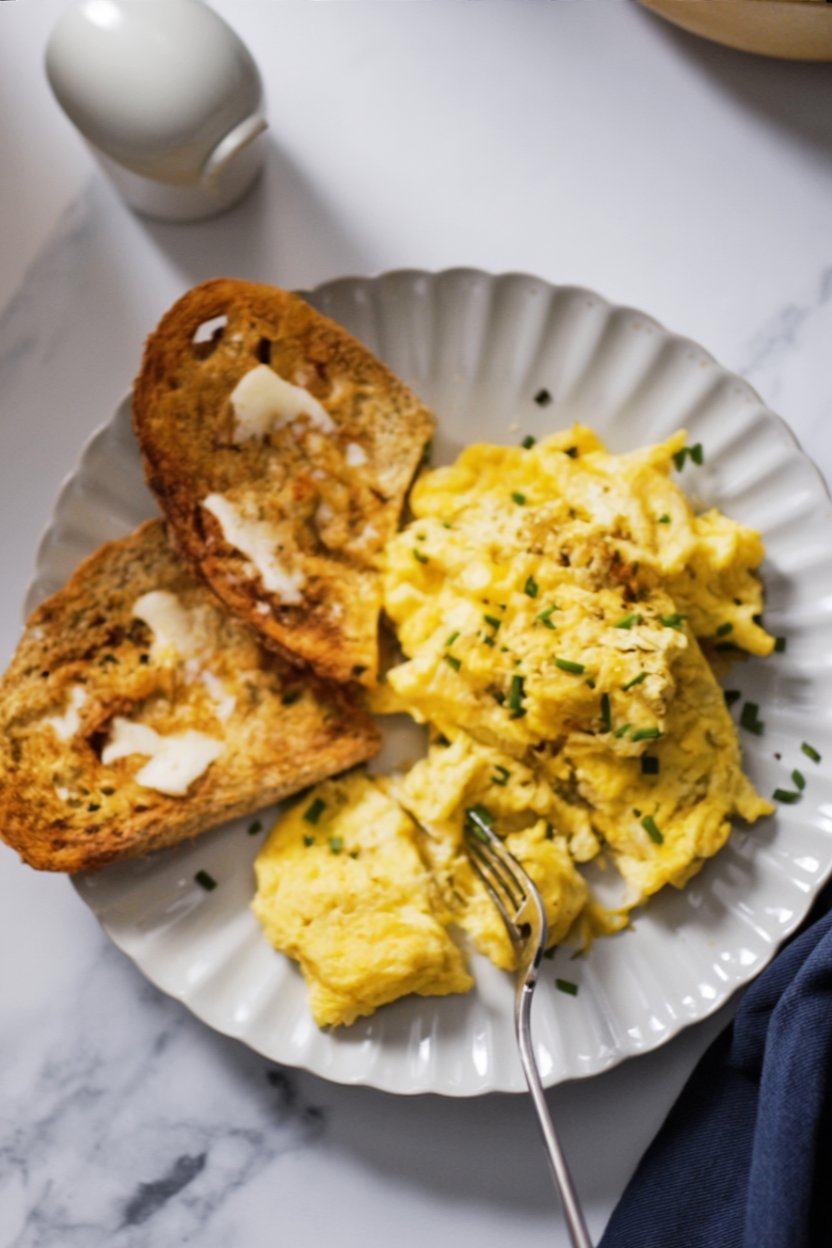
We have all been there: sitting down to breakfast only to be disappointed by dry, rubbery curds that require a gallon of ketchup to be palatable. It is a common misconception that because scrambled eggs are “easy” to make, they don’t require technique. The truth is, achieving truly Fluffy and Tender Scrambled Eggs is an art form rooted in science—specifically, temperature control and timing.
- Ingredients
- Timing
- Step-by-Step Instructions
- Step 1: Whisk the Mixture
- Step 2: Heat the Butter
- Step 3: The “Push and Fold” Technique
- Step 4: The Carryover Finish
- Variation: Cooking for a Crowd
- Nutritional Information
- Healthier Alternatives
- Serving Suggestions
- Common Mistakes to Avoid
- Storing Tips
- Conclusion
- FAQs
- Q1. Can I use water instead of milk?
- Q2. Why did my eggs turn grey/green?
- Q3. Can I use a metal spatula?
- Fluffy and Tender Scrambled Eggs: The Secret to Perfection
I used to overcook my eggs religiously until I discovered the power of carryover cooking. This recipe isn’t just about the ingredients; it is about the method. By removing the pan from the heat before the eggs look done and letting them steam to finish, you achieve a custard-like consistency that melts in your mouth. Whether you are cooking a quick breakfast for one or scaling up for a brunch crowd, this guide will change the way you cook eggs forever.
Ingredients
To create the perfect breakfast, you need simple, high-quality ingredients. The ratio of liquid to egg is crucial here to ensure the steam creates that desirable fluffiness without making the eggs watery.
| Ingredient | Amount/Quantity | Notes |
| Large Eggs | 5 | Fresh eggs yield a richer yolk color. |
| Milk | 2 tablespoons | Adds creaminess and steam for fluffiness. |
| Table Salt | ⅛–¼ teaspoon | Seasoning early helps break down proteins. |
| Pepper | Pinch to ⅛ tsp | Optional; freshly ground is best. |
| Unsalted Butter | 1 tablespoon | Controls the salt level and adds richness. |

Timing
This recipe is incredibly fast, making it perfect for busy mornings. The key is to move quickly once the eggs hit the pan.
- Prep Time: 2 minutes
- Cook Time: 3–5 minutes (including resting time)
- Total Time: ~7 minutes (About 80% quicker than making pancakes!)
Step-by-Step Instructions
Follow these steps closely. The difference between “good” and “perfect” lies in the visual cues described below, particularly the “broad trail” test.
Step 1: Whisk the Mixture
Crack your 5 large eggs into a medium mixing bowl. Add the 2 tablespoons of milk, salt, and pepper (if using). Beat vigorously with a whisk or fork until the mixture is completely uniform and pale yellow.
- Tip: You want to incorporate air bubbles now, not later in the pan. Whisk until no streaks of white remain.
Step 2: Heat the Butter
Place an 8-inch nonstick skillet over medium heat. Add the 1 tablespoon of unsalted butter. Swirl the skillet gently to distribute the melting butter across the entire bottom surface. Wait for the butter to sizzle evenly across the pan—this indicates the pan is at the perfect temperature to sear the eggs without burning them.
- Action: Once sizzling, pour in the egg mixture and immediately increase the heat to medium-high.
Step 3: The “Push and Fold” Technique
This is the most active step. As soon as the eggs hit the pan, begin scraping along the bottom and sides of the skillet slowly but constantly with a silicone spatula.
- Visual Cue: You are looking for large, soft curds. Continue this motion for about 2 minutes. You know it is time to stop when the eggs begin to clump together and the spatula leaves a broad trail on the bottom of the pan that doesn’t fill in immediately.
Step 4: The Carryover Finish
Here is the secret to Fluffy and Tender Scrambled Eggs. The moment you see that broad trail, remove the skillet from the heat. Use your spatula to break the eggs into large clumps. Cover the pan immediately with a tight-fitting lid (or a plate if you don’t have a lid). Let it sit for 1 to 3 minutes.
- Why this works: The residual heat steams the eggs to perfection, ensuring no runny raw egg remains, but prevents the dryness caused by direct heat.
Variation: Cooking for a Crowd
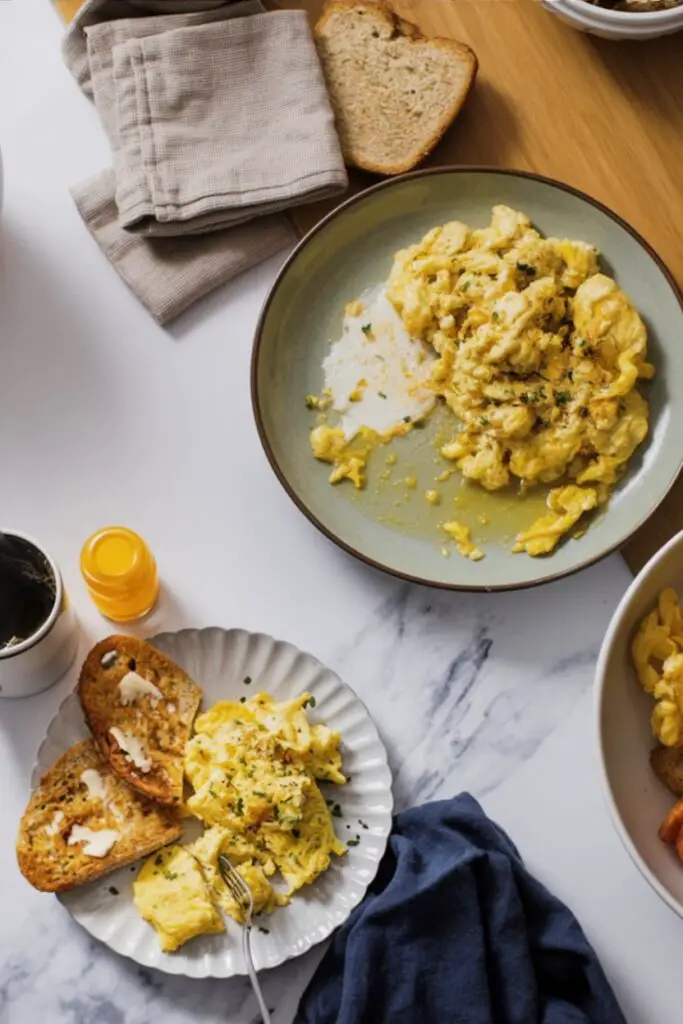
If you are hosting, you can easily scale this up.
- Ingredients: Use 24 eggs, ½ cup milk, ¾ teaspoon salt, and ¼–¾ teaspoon pepper. Increase butter to 2 tablespoons.
- Equipment: Switch to a 12-inch nonstick skillet.
- Timing: Increase the active cooking time (Step 3) to 5–7 minutes, and the covered resting time (Step 4) to 2–4 minutes.
Nutritional Information
Eggs are a nutritional powerhouse, providing high-quality protein and essential fats. Here is an estimated breakdown per serving (based on 2 servings):
- Calories: ~230 kcal
- Protein: 16 g (Excellent for satiety)
- Carbohydrates: 2 g
- Fat: 18 g (Saturated: 8 g)
- Cholesterol: 470 mg
- Choline: Rich source (essential for brain health)
Healthier Alternatives
While butter and whole milk create the richest flavor, you can adapt this recipe to fit specific dietary goals:
- Lower Fat: Swap the whole milk for skim milk or water. Water actually creates very fluffy eggs (due to steam), though they will be less creamy. You can also use olive oil spray instead of butter.
- Dairy-Free: Substitute the milk with unsweetened almond milk or oat milk. Use vegan butter or olive oil for the pan.
- Cholesterol Conscious: Use 3 whole eggs and 4 egg whites. This reduces the cholesterol while maintaining the volume.
- Boost the Veggies: Stir in a handful of baby spinach or diced bell peppers during the last minute of active cooking (Step 3) to add fiber and vitamins.
Serving Suggestions
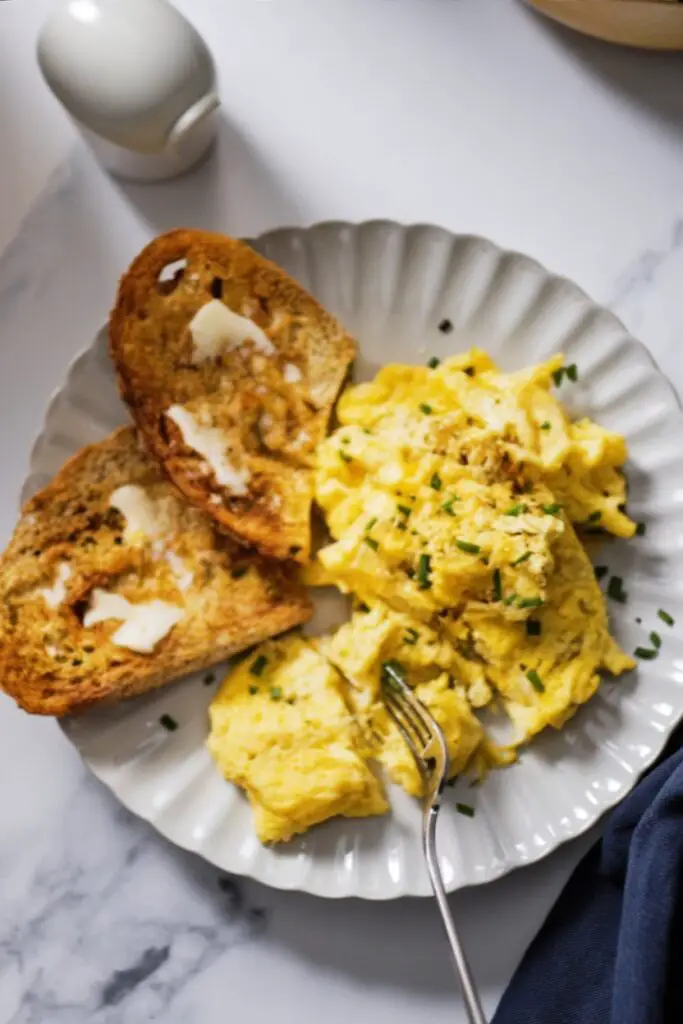
These eggs are delicate and creamy, so they pair best with contrasting textures.
- Classic Breakfast: Serve alongside crispy bacon and a slice of sourdough toast. The crunch of the toast compliments the tender curds.
- Herbal Freshness: Sprinkle with fresh chives or dill right before serving. The heat of the eggs will release the herb’s oils.
- The “Fancy” Touch: Serve the eggs on top of a bagel with smoked salmon and capers for a luxurious brunch feel.
- Tex-Mex Twist: Serve with a side of salsa and avocado slices for a nutrient-dense start to the day.
Common Mistakes to Avoid
Even seasoned cooks make these errors. Avoid them to ensure your eggs remain tender.
- Overcooking on the stove: Leaving the pan on the heat until the eggs look “done” guarantees they will be dry by the time they hit the plate. Solution: Trust the “cover and sit” method. Take them off the heat while they still look slightly wet.
- Using the wrong pan: Stainless steel or cast iron can cause sticking, forcing you to use too much oil or tear the eggs. Solution: Always use a pristine nonstick skillet for delicate eggs.
- Seasoning too late: Adding salt at the end leaves you with salty spots and bland eggs. Solution: Whisk the salt in at the beginning; it actually helps the eggs retain moisture.
- Vigorous Scrambling: Chopping the eggs frantically results in tiny, dry rubber bits. Solution: Use long, sweeping strokes with the spatula to create luscious, large curds.
Storing Tips
Scrambled eggs are notoriously best eaten fresh, but if you have leftovers, here is how to handle them.
- Refrigerate: Place leftovers in an airtight container in the fridge for up to 3 days.
- Reheat: This is tricky. The microwave often makes them rubbery. Tip: Reheat them gently in a skillet over low heat with a teaspoon of water or butter to re-introduce moisture. Alternatively, microwave on 50% power in 30-second intervals.
- Freezing: It is generally not recommended to freeze fully cooked scrambled eggs as the texture becomes spongy and releases water upon thawing.
Conclusion
Mastering Fluffy and Tender Scrambled Eggs is a culinary life skill that pays dividends every morning. By respecting the delicate nature of the egg and utilizing the “carryover cooking” technique—removing the pan from heat and covering it—you eliminate the margin for error. No more dry, brown, or rubbery breakfasts. Just creamy, golden perfection.
Try it out and let us know in the comments how the “cover and sit” technique worked for you! Did you notice the difference in texture? We’d love to hear your feedback. Don’t forget to rate the recipe and subscribe to our blog for more kitchen science hacks delivered straight to your inbox.
FAQs
Q1. Can I use water instead of milk?
Yes, you can. Interestingly, water makes eggs fluffier because it creates steam more efficiently than milk. However, milk adds fat and proteins that make the eggs taste richer and creamier. It is a matter of preference: water for fluffiness, milk for richness.
Q2. Why did my eggs turn grey/green?
This usually happens due to overcooking or high heat, which causes a chemical reaction between the iron in the yolk and the sulfur in the white. To avoid this, keep the heat at medium-high initially but remove the pan promptly as per the instructions.
Q3. Can I use a metal spatula?
It is not recommended. A metal spatula can scratch your nonstick coating (ruining the pan) and tends to cut the eggs rather than fold them. A silicone spatula is flexible, allowing you to scrape the curve of the pan cleanly, ensuring no egg gets left behind to burn.
Print
Fluffy and Tender Scrambled Eggs: The Secret to Perfection
- Total Time: 7 minutes
- Yield: 2 servings 1x
Description
Dreamy, custard-soft scrambled eggs made with smart temperature control and carryover cooking. Remove from the heat before they look done, cover, and let steam to fluffy perfection—no dry curds, ever.
Ingredients
Main Ingredients
- 5 large eggs (fresh for richer color)
- 2 tbsp milk (adds creaminess and steam)
- 1/8–1/4 tsp table salt (season to taste)
- pinch-1/8 tsp black pepper (freshly ground, optional)
- 1 tbsp unsalted butter (for the pan)
Instructions
- Whisk: In a bowl, whisk eggs, milk, salt, and pepper until completely uniform and pale yellow—no streaks of white remain.
- Heat Butter: Warm an 8-inch nonstick skillet over medium heat. Add butter and swirl to coat; when it sizzles evenly, pour in eggs and nudge heat to medium‑high.
- Push & Fold: Using a silicone spatula, slowly and constantly scrape the bottom and sides, pushing and folding to form large, soft curds (about 2 minutes). Stop when the spatula leaves a broad trail that doesn’t fill in immediately.
- Carryover Finish: Remove skillet from heat. Break curds into large clumps, cover with a lid or plate, and steam off heat 1–3 minutes until just set and custardy.
- Serve: Uncover, gently fluff, and plate immediately. Adjust seasoning to taste.
Notes
Crowd version: 24 eggs, 1/2 cup milk, 3/4 tsp salt, 1/4–3/4 tsp pepper; 12-inch skillet; 5–7 minutes active cooking and 2–4 minutes covered. For extra richness, whisk in 1 tbsp soft butter per 4 eggs. Avoid high heat; overcooking causes weeping and rubbery texture.
- Prep Time: 2 minutes
- Cook Time: 5 minutes
- Category: Breakfast, Brunch
- Cuisine: American
Nutrition
- Calories: 230
- Fat: 18
- Saturated Fat: 8
- Carbohydrates: 2
- Protein: 16
- Cholesterol: 470