



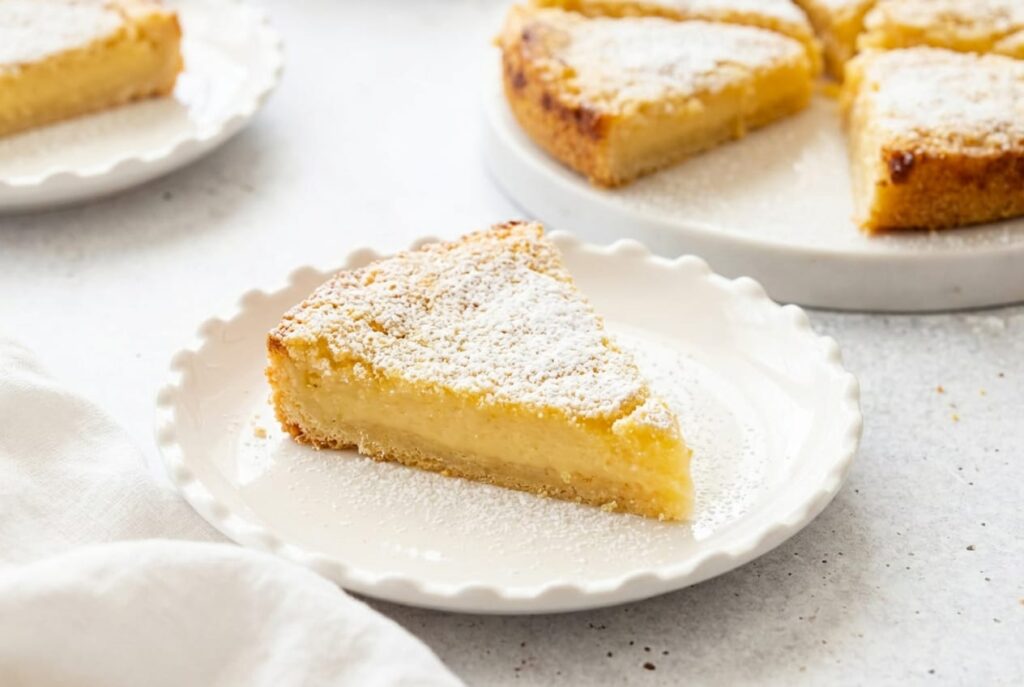
Some cakes try too hard. Layers upon layers, frosting piped into oblivion, seventeen ingredients you can’t pronounce. And then there’s this one. This lemon curd cake is quietly extraordinary — a crumbly, buttery shortcake base, a layer of homemade lemon curd so silky and tart it makes your eyes close, and a golden crumble scattered on top that shatters when your fork breaks through. Six ingredients for the cake. Four for the curd. And it’s completely gluten-free without tasting like a compromise.
I first made it for someone who couldn’t eat gluten and was tired of being handed sad, cardboard-textured desserts at every gathering. The look on her face after the first bite told me everything.
A Cake and Its Curd — How This All Fits Together
Before we get into ingredients and steps, I want you to understand the architecture of this cake because it’s a little different from what you might expect.
You’re making a crumbly shortcake dough in a food processor. Two-thirds of it gets pressed into the bottom of a springform pan. Then you make a quick stovetop lemon curd, pour it hot over the base, and crumble the remaining third of dough on top. It bakes into this beautiful, golden, layered thing — crisp on the edges, tender inside, with that bright lemon filling running through the center like a secret.
Prep: 15 minutes | Bake: 30 minutes | Cooling: 45–60 minutes | Total: About 1.5 hours | Serves: 8
The active time is maybe 20 minutes. The rest is the oven and patience doing their thing.
What Goes Into Each Layer
The Cake
| Ingredient | Amount | What It Brings |
|---|---|---|
| Gluten-free all-purpose flour | 1 cup (150g) | The base — see note below on flour choice |
| Baking powder | 2 tsp | A subtle lift that keeps things tender, not dense |
| Caster/superfine sugar | ½ cup (115g) | Fine-grained sweetness that dissolves right into the crumb |
| Unsalted butter, cool room temp | ¼ cup (60g) | Rich, crumbly, shortbread-like texture |
| Large egg, lightly beaten | 1 | Binds everything just enough without making it cakey |
| Powdered sugar | For dusting | A snowy finish that makes it look bakery-perfect |
The Lemon Curd Filling
| Ingredient | Amount | What It Brings |
|---|---|---|
| Fresh lemon juice, strained | ½ cup (120ml) | Bright, punchy, unmistakably tart |
| Caster/superfine sugar | ½ cup (115g) | Balances the acidity into something silky-sweet |
| Large egg, lightly beaten | 1 | Thickens and enriches the curd into velvet |
| Unsalted butter, cubed | ¼ cup (60g) | Glossy body and a luscious finish |

On the flour: Not all gluten-free flour blends behave the same. Look for one that contains xanthan gum or add ½ teaspoon yourself — it helps the crumb hold together instead of crumbling into dust. And if you’re not avoiding gluten? Regular all-purpose flour works perfectly here too, same measurements.
Where This Delicate Little Cake Can Go Wrong
I’m tucking these right here between the ingredients and the steps because this cake is simple but particular. A few small details make the difference between elegant and disappointing.
1. Over-processing the dough. You want the food processor to pulse until the mixture just barely starts to come together. It should still look a little crumbly when you tip it out. If you process it into a smooth ball of dough, you’ve gone too far — the baked texture will be tough instead of that gorgeous, shortbread-like crumble.
2. Cranking up the heat on the lemon curd. Low heat. The whole time. I know it feels slow. I know you’re watching butter melt and thinking “this would go faster on high.” But high heat scrambles the egg instantly, and you’ll end up with lemony scrambled eggs instead of glossy curd. Stir constantly, keep it gentle, and you’ll be rewarded with something magnificent.
3. Removing the cake from the pan too soon. Gluten-free baked goods are more fragile than their wheat-based cousins. This cake must cool completely in the springform pan before you even think about removing the ring. Warm cake plus no gluten structure equals crumble city. Let it sit. Let it set. Then release.
4. Forgetting to strain the lemon juice. Seeds and pulp in your curd will give it a grainy, lumpy texture. A quick strain through a fine mesh sieve takes ten seconds and keeps everything perfectly smooth.
5. Uneven base thickness. When you’re pressing that two-thirds of dough into the pan, take your time. Use the flat bottom of a glass or measuring cup to get it even. Thin spots bake faster and can burn, while thick spots stay underdone. Evenness is everything.
Building It, Layer by Layer
Heat the Oven and Prep the Pan
Preheat to 180°C (355°F). Grease a 17cm (6.5-inch) springform tin and line the base and sides with non-stick baking paper. The lining is your insurance — especially with gluten-free baking, where things like to stick.
Pulse the Dough in Seconds
Add the flour, baking powder, sugar, cool butter, and beaten egg to a food processor fitted with the steel blade. Pulse in short bursts — you’re looking for a crumbly, just-coming-together texture. Stop before it forms a ball. Tip the mixture onto a sheet of cling wrap.
Press and Reserve
Gently bring the mixture together with your hands. Divide it: two-thirds gets pressed firmly and evenly into the base of your prepared tin. The remaining one-third stays on the cling wrap, set aside for the topping. If you want to be precise, weigh it — I do, and it makes a real difference in how evenly the cake bakes.
Make the Lemon Curd While the Base Waits
Place all the curd ingredients — lemon juice, sugar, beaten egg, and cubed butter — into a saucepan together. Set it over low heat and stir continuously. You’ll watch the butter melt first, then the mixture will slowly begin to thicken. Keep stirring. It’s ready when it coats the back of your spoon and has that glossy, pudding-like consistency. This happens just below boiling point — you should see the faintest wisp of steam but no bubbles.
Remove from heat immediately.
Pour, Crumble, Bake
Pour the hot lemon curd directly over the pressed cake base. Spread it gently into an even layer. Now take that reserved third of dough and crumble it over the top as evenly as you can — it doesn’t need to be perfect. The crumble will spread and melt slightly as it bakes, filling in the gaps into a gorgeous golden patchwork.
Slide into the oven and bake for 30 minutes, until the top is lightly golden brown and the edges look set.
The Hardest Part: Letting It Cool
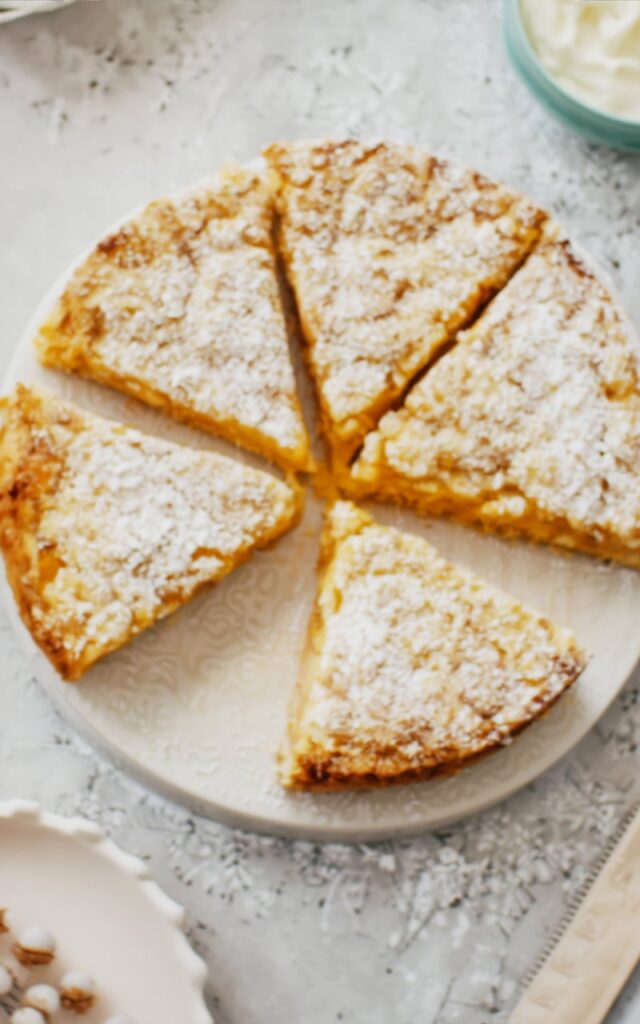
Pull the cake from the oven and leave it in the pan. Do not touch the springform ring. Let it cool completely — 45 minutes to an hour minimum. The curd needs to set and the crumb needs to firm up. Once it’s fully cool, gently release the springform side. Peel away the baking paper, transfer to a serving plate, and dust the top with a generous shower of powdered sugar through a fine sieve.
Stand back. Admire it. You made that.
What Every Slice Is Made Of
Per serving (1 of 8):
| Nutrient | Amount |
|---|---|
| Calories | ~245 |
| Fat | ~11 g |
| Saturated Fat | ~7 g |
| Carbohydrates | ~35 g |
| Sugar | ~24 g |
| Protein | ~3 g |
| Fiber | ~0.5 g |
| Sodium | ~90 mg |
A nice detail: For a cake with this much flavor and richness, the calorie count is surprisingly restrained. The portions are naturally modest — this is a petite, European-style tea cake, not a towering layer cake. Each slice delivers maximum satisfaction without excess.
The Afternoon This Cake Was Made For
- On a pretty plate with a generous dollop of softly whipped cream — the cool cream against the tart curd is heavenly.
- Alongside a warm cup of Earl Grey or English breakfast tea, letting the lemon and bergamot play off each other.
- With a scoop of good vanilla ice cream that melts slowly against the warm, crumbly edges.
- Served at room temperature on a cake stand at the center of a brunch table — it looks effortlessly elegant.
- Wrapped in parchment and tied with twine as a gift for someone who thinks gluten-free desserts can’t be beautiful.
This Is the Cake That Changes Minds
I’ve baked this lemon curd cake for people who eat gluten every day of their lives, and not a single one has guessed it was gluten-free until I told them. That’s the highest compliment a recipe like this can get — it doesn’t taste like a workaround. It tastes like a proper, beautiful, European-style tea cake that happens to welcome everyone to the table.
So bake it for someone you love. Bake it for yourself on a quiet afternoon. Dust it with sugar, slice it thin, and let that bright lemon filling do the talking. Then come back and leave a comment telling me about it — who you baked it for, what tea you paired it with, whether you licked the curd spoon. Rate the recipe so other bakers can discover it, and subscribe so you’re first in line when the next one drops.
That first bite is going to stop you mid-sentence. I promise.
Print
Lemon Curd Cake (Gluten-Free)
A delicate, buttery crumble cake with a silky homemade lemon curd filling, naturally gluten-free and elegant enough for any occasion. A crumbly shortcake base, bright lemon curd center, and golden crumble topping dusted with powdered sugar. Simple ingredients, stunning results.
- Total Time1 hour 30 minutes
- Yield8 slices 1x
Ingredients
Cake
- 1 cup gluten-free all-purpose flour (150g)
- 2 teaspoons baking powder
- 1/2 cup caster/superfine sugar (115g)
- 1/4 cup unsalted butter (60g), at cool room temperature
- 1 large egg, lightly beaten, at room temperature
- icing/powdered sugar, for dusting
Lemon Curd Filling
- 1/2 cup lemon juice (120ml), strained
- 1/2 cup caster/superfine sugar (115g)
- 1 large egg, lightly beaten
- 1/4 cup unsalted butter (60g), cut into cubes
Instructions
Cake
- Preheat and Prepare Pan: Preheat oven to 180°C (355°F). Grease and line the base and sides of a 17cm (6.5″) springform tin with non-stick baking paper.
- Pulse the Dough: Add the flour, baking powder, sugar, cool room temperature butter, and lightly beaten egg to a food processor fitted with a steel blade. Pulse until the mixture just starts to come together — it should still look crumbly. Do not process until it forms a ball.
- Press and Reserve: Tip the mixture onto cling wrap. Gently bring it together, then divide: press two-thirds firmly into the base of the prepared tin. Reserve the remaining one-third for the topping. Weigh for accuracy if desired.
- Make Lemon Curd: Place all curd ingredients (lemon juice, sugar, beaten egg, cubed butter) in a saucepan. Over low heat, stir continuously until the butter melts and the curd thickens just below boiling point. Do not use high heat or the egg will scramble. Remove from heat immediately once thickened.
- Assemble: Pour the hot lemon curd onto the cake base. Crumble the reserved dough mixture as evenly as possible over the top of the curd.
- Bake: Bake for approximately 30 minutes, until lightly golden brown on top.
- Cool Completely: Remove from the oven and cool completely in the pan. Gluten-free baked goods are fragile — do not remove from the tin until fully cooled.
- Unmold and Serve: Gently remove the side of the springform tin. Remove the baking paper, place the cake on a serving platter, and dust generously with powdered sugar. Serve on its own, with whipped cream, or with vanilla ice cream.
Notes
Not all gluten-free flour blends are equal — look for one containing xanthan gum, or add ½ teaspoon yourself for better structure. Regular all-purpose flour can be substituted using the same measurements if gluten is not a concern. Always strain the lemon juice to remove seeds and pulp for a smooth curd. Keep the heat low and stir constantly when making the curd to prevent scrambling the egg. The cake must cool completely in the springform tin before removing — warm gluten-free baked goods are very fragile. Weigh the dough when dividing for the most even results.
- Prep Time: 15 minutes
- Cook Time: 30 minutes
- Category: Cake, Dessert, Tea Cake
- Cuisine: British, European
Nutrition
- Calories: 245
- Sugar: 24
- Sodium: 90
- Fat: 11
- Saturated Fat: 7
- Carbohydrates: 35
- Fiber: 0.5
- Protein: 3
- Cholesterol: 70