


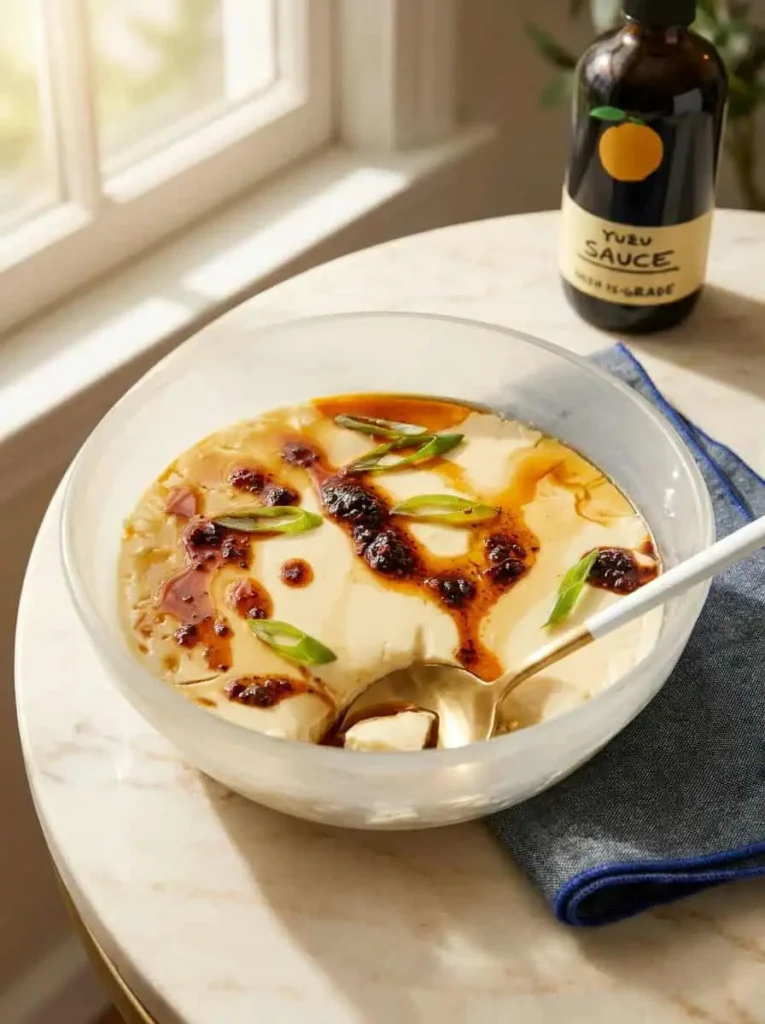
Chawanmushi is one of the most elegant things you can make from a couple of eggs, and this version comes together in the microwave in minutes. It’s a silky, savory Japanese steamed egg custard, delicate and just barely set, with a deep savory flavor from dashi (the classic Japanese stock made from kombu kelp and often bonito). Topped with toasted seaweed, sesame seeds, and a drizzle of sesame oil, it’s light, comforting, and full of gentle umami. Traditionally chawanmushi is steamed, but the microwave makes it genuinely quick and approachable without losing that signature trembling, custardy texture.
What makes this so appealing is the contrast between how simple it is and how refined it tastes. With just eggs and dashi as the base, you get a custard that’s smooth as silk and savory rather than sweet, the kind of thing you’d be served at a nice Japanese restaurant. This particular version uses a higher ratio of liquid to egg than a firmer steamed egg, which is the secret to an especially silky, soft custard. It’s lovely warm as a light starter or snack, or chilled and dressed up for an appetizer.
Why this works
A few small techniques are what give chawanmushi its famously smooth, set-but-trembling texture, and they’re worth understanding.
The whole dish is about the egg-to-liquid ratio and gentle cooking. Eggs set when heated, but heat them too hard or too fast and they turn rubbery, grainy, or full of holes. Chawanmushi avoids that with a generous amount of liquid relative to egg and a low, gentle cook, which is why this recipe uses a medium power level in the microwave rather than full blast. Low and slow is what gives you a tender, just-set custard instead of scrambled eggs.
Two prep steps matter a lot for smoothness. First, beat the eggs very well, so they’re completely uniform with no stringy bits of white, which helps the custard set evenly and silky. Second, skim or strain off the bubbles and foam from the surface before cooking, since those bubbles would otherwise create a pocked, uneven texture on top. Straining the mixture gives you that glassy, smooth surface.
The dashi is the soul of the dish. It provides the savory, umami backbone that makes chawanmushi taste like more than just steamed egg. You can use store-bought instant dashi (hondashi granules dissolved in water) or a dashi concentrate, or make your own from kombu, whichever is easiest. A little soy sauce and a touch of sweetness round out the seasoning.
And the key to not overcooking is watching for the right doneness: the custard should be barely set and jiggle uniformly, like flan, when you gently nudge it. If the center is still soupy, you add time in short bursts, but you stop the moment it’s set, since carryover heat keeps cooking it.
What goes in
The ingredient list is short and built around the egg and dashi.

For the custard, you’ll need cold dashi stock (from instant hondashi, concentrate, or homemade), an egg, a little soy sauce, and a touch of agave or sugar for balance.
For the toppings, roasted seaweed (Korean gim or Japanese nori), sesame seeds, and a drizzle of sesame oil.
A few notes. Use cold dashi so it mixes smoothly into the beaten egg without starting to cook it. Instant dashi is the easy route, just dissolve hondashi granules in water; the recipe’s ratio is about a teaspoon per cup of water. The small amount of agave or sugar isn’t there to make it sweet, just to balance the savory and salty notes. And the roasted seaweed, sesame, and sesame oil on top add texture, nuttiness, and aroma that make the finished custard special, so don’t skip them.
How to make it
Whisk together the egg, soy sauce, and agave (or sugar) in a microwave-safe dish until the egg is very well beaten and completely smooth. Thorough beating here is what gives you a silky custard, so don’t rush it.
Slowly pour the cold dashi into the egg, stirring gently to combine without creating a lot of froth. Then use a small strainer or spoon to skim the bubbles and foam off the surface, this is what gives the finished custard its smooth top.
Cover the dish (with a vented lid or loosely with microwave-safe wrap) and cook at a medium power level, about 50%, not full power. This gentle heat is essential for a tender custard. Cook for around 3 to 4 minutes, then check: the custard should be barely set and jiggle uniformly like flan when gently moved.
If the center still looks too soupy, continue cooking in 30-second bursts at the same medium power, checking each time, until it’s just set. Be careful not to overcook, since the custard firms up a little from residual heat after it comes out, and overcooking turns it rubbery and full of holes.
Top the warm custard with chopped or crumbled roasted seaweed and sesame seeds, drizzle with sesame oil, and serve.
Tips, variations, and storing
A few things make the difference between a silky custard and a rubbery one. Beat the eggs thoroughly and strain off the bubbles for a smooth texture. Cook on medium power, never high, since high heat is what makes egg custard seize and turn grainy. And watch the doneness closely, pulling it the moment it’s just set and jiggly, since microwaves vary a lot even at the same wattage, so treat the times as a starting point and go by how it looks.
This base is wonderfully adaptable. For a spicy kick, top it with a spoonful of chili crisp. For an elegant appetizer, chill it and crown it with tobiko or salmon roe. And to make it a full meal, spoon it over a bowl of warm rice. Traditional chawanmushi also often hides little treasures in the custard, like a piece of shrimp, a slice of mushroom, or a bit of chicken, which you can add to the dish before cooking if you’d like a heartier version.
On serving: chawanmushi is traditionally enjoyed warm, but it’s also lovely chilled, so it works year-round. It’s best made fresh and eaten soon after, while the texture is at its silkiest. If you do have leftovers, cover and refrigerate them and eat within a day or two, enjoyed cold, since reheating egg custard tends to toughen it. I wouldn’t freeze it, as the texture won’t survive thawing.
This makes a single serving, and it scales up easily, the classic ratio is about 7 eggs per quart of liquid if you want to make a bigger batch. Silky, savory, and quietly luxurious, microwave chawanmushi is proof that one of the most elegant dishes in Japanese home cooking can be one of the easiest, ready in minutes whenever you want a little something special.
WP Tasty (Tasty Recipes Premium) field values
- Category: Appetizer
- Method: Microwave
- Cuisine: Japanese
- Diet: Gluten Free (use gluten-free soy sauce/tamari and check your dashi, since some contain wheat. Note: traditional dashi contains bonito (fish), so it’s not vegetarian unless you use a kombu-only or vegan dashi.)
- Keywords: chawanmushi, Japanese egg custard, savory egg custard, microwave chawanmushi, steamed egg custard, dashi egg custard
- Serving Size: 1 serving (scales up; classic ratio 7 eggs per quart liquid)
- Calories: (leave blank. No nutrition data was provided. Generate values with Nutrifox before publishing rather than estimating.)
- Equipment: Microwave-safe dish with lid, whisk, small strainer
Microwave Chawanmushi (Japanese Savory Egg Custard)

Equipment
- Microwave-safe dish with lid
- Whisk
- Small strainer
Ingredients
- 1/2 cup cold dashi stock 115 ml; store-bought hondashi, concentrate, or homemade
- 1 egg very well beaten
- 1/2 tsp soy sauce use tamari for gluten-free
- 1 tsp agave or sugar
- 1-2 small sheets roasted seaweed (gim or nori) or 1 larger sheet
- 1 tsp sesame seeds
- 1/2 tsp sesame oil
Instructions
- Beat the Egg: Whisk together the egg, soy sauce, and agave (or sugar) in a microwave-safe dish until the egg is very well beaten and smooth, which helps the custard set silky.
- Add the Dashi: Slowly pour the cold dashi into the egg, stirring gently to combine. Use a small strainer to skim the bubbles from the surface for a smooth custard.
- Cook: Cover (vented) and microwave at a medium power level (about 50%), not full power, for 3 to 4 minutes, until the custard is barely set and jiggles uniformly like flan.
- Check: If the center is still soupy, cook in 30-second bursts at the same medium power until just set, being careful not to overcook (it firms up from residual heat).
- Top and Serve: Top with chopped or crumbled roasted seaweed and sesame seeds, drizzle with sesame oil, and enjoy.