



These little tarts are one of Portugal’s most beloved treats, and this vegan version lets everyone enjoy them. Pastéis de nata are classic Portuguese custard tarts: crisp, flaky puff pastry shells filled with a creamy, lightly spiced custard that bakes up golden with those signature caramelized, dark-spotted tops. This dairy-free, egg-free take swaps in coconut milk, soya cream, and soya milk for a rich, silky custard, and it tastes wonderfully close to the original. Warm from the oven with a dusting of cinnamon, they’re a special-feeling dessert that’s surprisingly simple to make at home. Whether you’re vegan or just love these iconic tarts, this recipe delivers all the comfort of a Lisbon café pastry.
The magic of pastéis de nata is the contrast between the shatteringly crisp, flaky pastry and the smooth, creamy custard inside, plus those characteristic caramelized tops from baking at a very high heat. This vegan version builds a thick, luscious custard from plant milks and cream, thickened with cornflour and flavored with vanilla, cinnamon, and lemon, so you don’t miss the eggs at all. With store-bought puff pastry doing the heavy lifting, they come together more easily than you might expect.
Why this works
A few simple techniques are what give these tarts their creamy custard and crisp shells, and they’re worth understanding.
The plant-based custard is rich and creamy thanks to a smart mix of coconut milk, soya cream, and soya milk. Coconut milk and soya cream bring richness and body (standing in for the dairy and eggs of a traditional custard), while cornflour thickens everything into a smooth, spoonable custard as it cooks. Vanilla, cinnamon, and a piece of lemon peel infuse it with that classic pastéis de nata flavor, warm, fragrant, and citrus-kissed.
Cooking the custard until it boils and thickens is the key step, and stirring constantly is essential. Heating the mixture over medium heat while stirring the whole time prevents lumps and scorching, and lets the cornflour work so you get a thick, glossy, pourable custard. Adding the salt at the end balances the sweetness.
Puff pastry is the shortcut that makes the shells easy. Rolling and pressing thin pieces of puff pastry into the molds gives you those crisp, flaky, layered shells without making pastry from scratch. Pressing it thin (but without tearing holes) is what lets it bake up crisp and shatter-y.
And the high oven heat is what makes them pastéis de nata. Baking at a very high temperature (250°C / about 480°F) is what puffs the pastry, sets the custard quickly, and, crucially, caramelizes the tops into those signature golden-brown, dark-spotted patches. Don’t be alarmed by the dark spots, they’re exactly what you want.
What goes in
The ingredient list is short and built around plant-based dairy swaps.

You’ll need puff pastry, coconut milk, soya cream, soya milk, vanilla essence (extract), cinnamon, cornflour (cornstarch), sugar, a small strip of lemon peel, and a pinch of salt.
A few notes. Use a good puff pastry (check that it’s vegan if that matters to you, many store brands are made with oil rather than butter). Cornflour here means cornstarch, which thickens the custard. Vanilla essence is vanilla extract, and the small skin of lemon is a strip of lemon peel to infuse the custard (remove it before filling). And you can swap the soya cream and milk for other plant-based cream and milk if you prefer, though richer options give the creamiest custard.
How to make them
Turn on the oven to 250°C (about 480°F) so it’s very hot.
In a pan, add the dry ingredients (except the salt), the cornflour, sugar, and cinnamon, along with the soya cream, and mix well. Add the remaining liquid ingredients, the coconut milk, soya milk, vanilla, and lemon peel, and mix again until smooth.
Heat over medium temperature, stirring constantly, until the mixture boils and thickens into a custard. Keep stirring the whole time so it doesn’t scorch or clump. Stir in the salt, then set the custard aside (remove the lemon peel).
Cut the puff pastry into small rolls. Fold each and press it into the walls of small tart molds, making the pastry as thin as you can without tearing any holes.
Fill each mold about halfway with the custard. Set the molds on a baking tray and bake for about 20 minutes, or until the custard is deeply golden with dark caramelized spots on top.
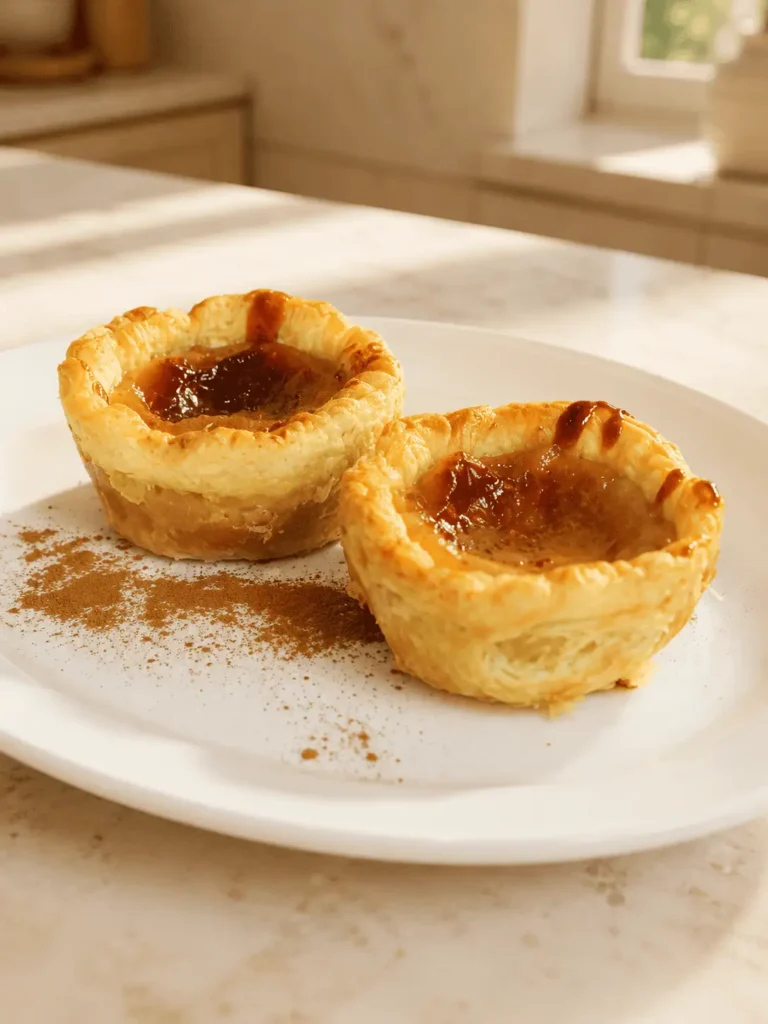
Serve the pastéis de nata warm, with a little cinnamon dusted over the top.
Tips, serving, and storing
A few things help. Stir the custard constantly as it cooks so it thickens smoothly without lumps or scorching. Press the puff pastry as thin as possible in the molds (without tearing) for the crispest shells. Bake at the high heat as directed so the tops caramelize, those dark spots are the hallmark of a good pastéis de nata. And fill the molds only about halfway, since the custard puffs as it bakes.
A couple more. If you don’t have traditional tart molds, a muffin tin works. And letting the tarts cool in the molds for a few minutes before removing helps them hold together, since they’re delicate when hot. A little extra cinnamon (or powdered sugar) on top before serving is traditional and lovely.
Pastéis de nata are at their absolute best warm and fresh from the oven, when the pastry is crispest and the custard is creamy, ideally with a coffee, just as they’re enjoyed in Portugal. They’re a wonderful dessert, brunch treat, or afternoon pick-me-up with tea or espresso.
For storing, keep any leftovers in an airtight container in the fridge for up to 2 to 3 days. The pastry will soften over time, so to bring back some crispness, warm them in a hot oven for a few minutes before serving rather than the microwave. They’re really meant to be eaten fresh, so they’re best made in a batch you’ll enjoy within a day or two.
This makes about 12 tarts. Crisp, flaky, creamy, and warmly spiced, these vegan pastéis de nata bring a taste of Portugal to your kitchen, and they prove that this beloved classic can be just as delicious without eggs or dairy.
Print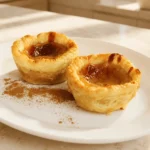
Pasteis de Nata (Vegan Portuguese Custard Tarts)
A vegan take on the classic Portuguese custard tart: crisp, flaky puff pastry shells filled with a creamy, lightly spiced custard made from coconut milk, soya cream, and soya milk, baked hot until golden with caramelized dark-spotted tops. Dairy-free and egg-free.
- Total Time35 minutes
- Yield12 tarts 1x
Ingredients
- 1 sheet puff pastry (check that it’s vegan)
- 200 ml coconut milk
- 1/2 cup soya cream
- 1/2 cup soya milk
- 1/2 tsp vanilla essence (vanilla extract)
- 1 tsp cinnamon (plus more for serving)
- 30 g cornflour (cornstarch)
- 100 g sugar
- 1 small strip lemon peel (remove before filling)
- 1 pinch salt
Instructions
- Preheat: Turn on the oven to 250°C (about 480°F) so it’s very hot.
- Combine: In a pan, add the dry ingredients (cornflour, sugar, cinnamon; not the salt) and the soya cream, and mix well. Add the coconut milk, soya milk, vanilla, and lemon peel, and mix again until smooth.
- Thicken the Custard: Heat over medium temperature, stirring constantly, until it boils and thickens. Keep stirring so it doesn’t scorch or clump. Stir in the salt and set aside (remove the lemon peel).
- Line the Molds: Cut the puff pastry into small rolls. Fold each and press into the walls of small molds, as thin as you can without tearing holes.
- Fill and Bake: Fill each mold about halfway with the custard. Set on a baking tray and bake about 20 minutes, until the custard is deeply golden with dark caramelized spots.
- Serve: Serve the pasteis de nata warm, with a little cinnamon dusted on top.
Notes
Stir the custard constantly as it cooks so it thickens smoothly without lumps or scorching. Press the puff pastry as thin as possible in the molds (without tearing) for the crispest shells. Bake at the high heat (250°C/480°F) so the tops caramelize, the dark spots are the hallmark of a good pastel de nata. Fill the molds only about halfway, since the custard puffs. A muffin tin works if you don’t have tart molds. Cool a few minutes before removing (they’re delicate when hot). Best fresh; keeps 2 to 3 days refrigerated, re-crisp in a hot oven. Note: the source listed prep time as both 12 and 15 minutes; 15 is used here.
- Prep Time: 15 minutes
- Cook Time: 20 minutes
- Category: Dessert
- Method: Baking
- Cuisine: Portuguese
Nutrition
- Serving Size: 1 tart (recipe makes 12)