



If you grew up in a Polish or Eastern European family, you already know the smell of these. Cabbage and tomato and meat going low and slow all afternoon, the kind of thing that meant somebody loved you enough to spend three hours on dinner. Polish stuffed cabbage rolls, gołąbki, are tender cabbage leaves wrapped around a soft filling of meat and rice, stacked in a heavy pot, and braised under a blanket of tomato until everything turns meltingly soft.
The Polish name, gołąbki, means something like “little pigeons,” which nobody can quite explain but everybody’s grandmother used. This is a make-it-on-a-Sunday recipe. It takes an afternoon, most of it hands-off once the rolls are in the pot, and it makes a big batch on purpose. You want leftovers. They’re better the next day.
Why these are worth the whole afternoon
There’s no fast version of this that tastes like the real thing, and that’s sort of the point. The time is what makes them. The long, gentle braise breaks the cabbage down until it’s silky, melds the tomato into the meat, and lets the rice finish cooking inside each roll so it’s plump and tender instead of crunchy.
What surprises people is how simple the flavor base is. A few strips of bacon get crisped in the bottom of the pot first, and that bacon grease is what every roll sits in while it cooks. It seasons the whole batch from underneath. Then there’s the condensed tomato soup poured over the top, undiluted, which is the old-school shortcut that a lot of Polish American families have used for generations. It’s not fussy or fancy, but it makes a sauce that tastes exactly like the version you remember.
The filling stays soft because of two things: parboiled rice and a genuinely moist mix. You want it wetter than feels right. A dry filling makes for a tight, heavy roll. A loose, moist one cooks up tender.
What goes into them

Meatloaf mix is the traditional choice, a blend of ground beef, veal, and pork, about two pounds of it. The three-meat mix gives you the richness from the pork, the structure from the beef, and the tenderness from the veal. If you can’t find it pre-blended, ask the butcher, or just use beef and pork in roughly equal parts. Straight ground beef works too, it’s only a little less tender.
Long grain white rice, parboiled for just four minutes before it goes in. This is important. You’re not cooking it through, only giving it a head start, because it finishes inside the rolls. Cook it all the way now and it turns to mush during the braise.
Bacon, three strips, crisped in the pot at the start. You’ll garnish with the crumbled bacon later and leave the grease behind for cooking.
A very large head of green cabbage, or two small ones. You need the leaves whole and pliable, so the head has to be steamed or boiled first to soften the leaves enough to peel and roll without cracking.
Condensed tomato soup, one family-size can (about 23 ounces), poured over undiluted. Don’t add water. It thickens into the sauce as the rolls cook. Beef broth goes into the filling to keep it moist, and stale bread or panko works as the binder.
Onion sautéed in butter, fresh parsley, and salt and pepper round out the filling. A spoonful of sugar is optional and cuts the acidity of the tomato if you like it a touch sweeter. For serving, sour cream and chopped fresh dill are the classic finish, and they’re worth it.
How to make them
Get your components ready first, because assembly goes faster when everything’s prepped. Parboil the rice in salted boiling water for four minutes, then drain it. Melt the butter in a skillet and cook the diced onion gently until it’s soft and translucent, around seven to ten minutes, then set it aside. In your Dutch oven, cook the chopped bacon until crisp, lift it out with a slotted spoon onto a paper towel, and leave that bacon grease in the pot.
Now soften the cabbage. The easiest way is to steam the whole head in a pan with a couple inches of water, microwaving in bursts and peeling off the outer leaves as they go soft and floppy, about ten to twelve minutes total. You can also boil the head in a big pot if you’d rather. Either way, you want leaves that bend without snapping.
For the filling, stir together the meat, parboiled rice, sautéed onion, crumbled bread, beef broth, and parsley with salt and pepper, plus that optional spoon of sugar. Mix until it’s combined and quite moist.
To roll, lay a cabbage leaf on a board and shave down the thick part of the core so the leaf folds easily. Put a heaping couple of tablespoons of filling at the core end, less for small leaves. Roll it once over the filling, fold in both sides, then keep rolling to close it. Don’t roll them tight. The rice swells as it cooks, and a too-tight roll will split and spill. A toothpick can hold a loose one together, but you usually won’t need it.
Set the rolls seam-side down in the Dutch oven, right on the bacon grease, stacking as you go, and season each layer lightly. Spread the undiluted tomato soup over the top. Cover, and cook over very low heat for an hour and a half to two hours.
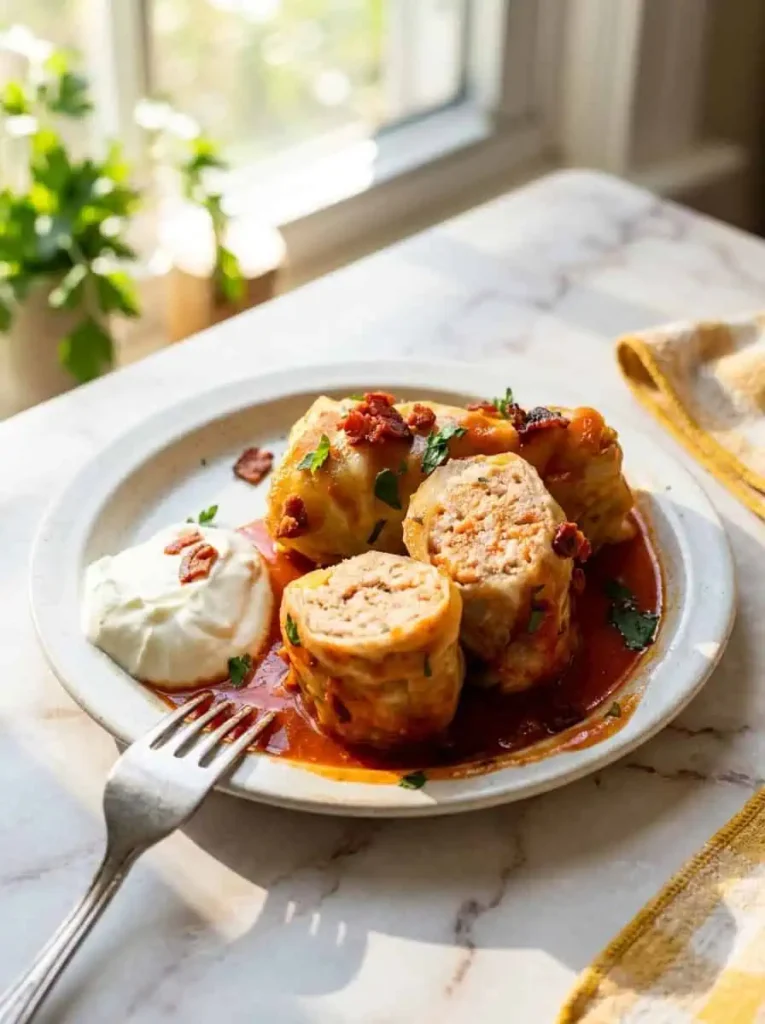
Finish with the reserved crumbled bacon, more fresh parsley, a spoon of sour cream, and dill if you’ve got it.
A few things worth knowing
The single most common mistake is rolling too tight. I know I keep saying it, but it’s the one that ruins a batch. Leave them a little loose and they’ll be fine.
If steaming the cabbage feels fiddly, there’s a freezer trick worth knowing. Freeze the whole head a day ahead, then thaw it, and the leaves come off limp and pliable with no cooking at all. It’s the lowest-effort method by far if you can plan ahead.
These reheat beautifully and honestly taste better on day two, once the flavors have settled. Keep leftovers covered in the fridge for three or four days. They also freeze well after cooking, sauce and all, so a big batch is never wasted. Thaw overnight and warm gently on the stove or in a low oven.
The recipe makes a lot, usually 22 to 24 rolls, enough for 10 to 12 people. Halve it if you’re not feeding a crowd, though I’d argue the leftovers are the best part.
Print
Polish Stuffed Cabbage Rolls (Gołąbki)
Hearty Polish stuffed cabbage rolls (gołąbki) made with tender cabbage leaves wrapped around a soft beef, veal, and pork filling with rice, braised low and slow under a rich tomato sauce. Just like Grandma used to make.
- Total Time2 hours 45 minutes
- Yield12 servings 1x
Ingredients
- 1 1/2 cups uncooked long grain white rice
- 2 tbsp salted butter
- 1 medium yellow onion (finely diced)
- 3 strips bacon (chopped)
- 1 very large head green cabbage (or 2 small heads)
- 2 lbs meatloaf mix (ground beef, veal, and pork)
- 2 slices stale bread (crumbled, or about 2/3 cup Panko breadcrumbs)
- 2 cups beef broth
- 2 tbsp fresh parsley (chopped, or 1 tablespoon dried parsley flakes)
- kosher salt and ground black pepper (to taste)
- 1 can condensed tomato soup (23.2 oz family-size can, undiluted)
- sour cream, fresh parsley, and fresh dill (optional garnish)
Instructions
- Parboil the Rice: Cook the rice in salted boiling water for 4 minutes, then drain and set aside. It will finish cooking inside the rolls.
- Sauté the Onion: Melt the butter in a skillet over medium heat. Sauté the onion just until tender, about 7 to 10 minutes, then set aside.
- Crisp the Bacon: In a large Dutch oven, cook the chopped bacon until crispy. Remove with a slotted spoon onto a paper towel-lined plate and set aside, leaving the bacon grease in the pot.
- Steam the Cabbage: Place the cabbage in a pan with about 2 inches of water and steam in the microwave for about 10 to 12 minutes total, until tender. Work in increments, removing the outer leaves as they soften. (Boiling or freezing the cabbage also works to soften the leaves.)
- Make the Filling: In a large bowl, stir together the ground meat, parboiled rice, sautéed onion, breadcrumbs, beef broth, and parsley. Add salt and pepper, and up to 1 tablespoon of sugar if desired. The mixture should be very moist.
- Fill the Leaves: Place a steamed cabbage leaf on a cutting board and trim a little of the thick core to make it easier to roll. Place a heaping 2 tablespoons of filling at the core end (use less for small leaves).
- Roll: Roll once over the filling, fold in each side, then continue rolling to seal. Do not roll too tightly, as the rice expands and a tight roll can tear or burst. Secure with a toothpick if you like, though it is usually not necessary. Repeat with the remaining leaves and filling.
- Layer in the Pot: Place the rolls seam-side down in the Dutch oven on the bacon grease, stacking as needed, and season with salt and pepper. Spread the undiluted condensed soup over the top.
- Cook Low and Slow: Cover with the lid and cook over very low heat for 1 1/2 to 2 hours.
- Garnish and Serve: Top the rolls with the reserved crumbled bacon, fresh parsley, and sour cream, if desired.
Notes
Do not roll the cabbage too tightly; the rice expands as it cooks and tight rolls can burst. To soften the cabbage with the least effort, freeze the whole head a day ahead, then thaw, and the leaves peel off limp with no cooking. The rolls taste even better on day two and freeze well after cooking, sauce and all. Yields about 22 to 24 rolls.
- Prep Time: 45 minutes
- Cook Time: 2 hours
- Category: Main Course
- Method: Braising
- Cuisine: Polish
Nutrition
- Calories: 373.7