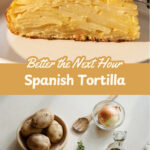




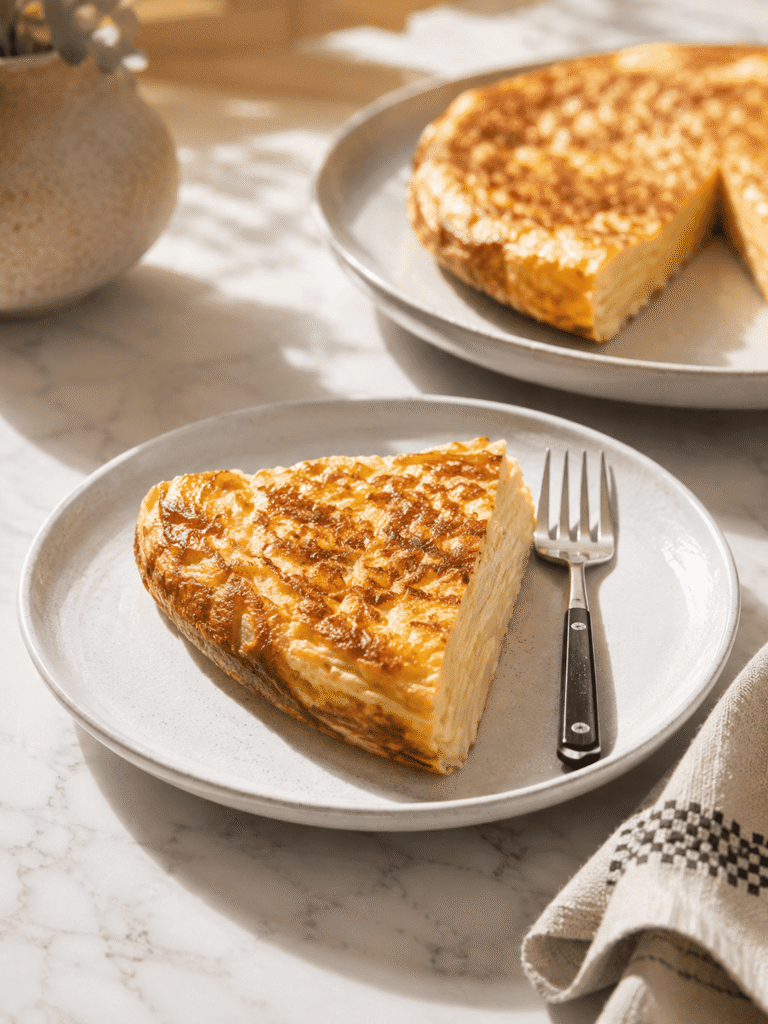
Despite the name, this has nothing to do with the Mexican tortilla you’re picturing. Spanish tortilla, or tortilla española, is a thick, open-faced potato and egg omelet, cooked slowly in olive oil until the potatoes are tender and the eggs set into a tender, custardy cake. It can be an appetizer, a snack, or a light meal, sliced into wedges and served warm or, even better, at room temperature. That’s actually one of its best qualities: because it tastes better once it’s had time to rest, it’s a genuinely great make-ahead dish, perfect for anywhere from 15 minutes to a few hours before serving. With just potatoes, eggs, onion, and good olive oil, it’s proof that a few humble ingredients, treated well, can become something special.
The heart of a good tortilla is patience: the potatoes and onion cook low and slow in plenty of olive oil until they’re meltingly tender (not browned), which is what gives the finished tortilla its soft, rich texture. Beaten eggs are folded in, and the whole thing is cooked into a thick, golden cake, flipped partway through so both sides set beautifully. It’s simple, but every step matters, and the reward is a dish that’s far greater than the sum of its parts.
Why this works
A few key techniques are what make a tortilla españla so good, and they’re worth understanding.
Cooking the potatoes gently in oil, not frying them, is essential. The potatoes (and onion, if using) are cooked slowly in a generous amount of olive oil over low-to-medium heat until they’re fully tender, essentially confit-style, rather than browned or crisped. This gentle approach is what makes the potatoes soft and creamy inside the finished tortilla, and it’s also where a lot of the tortilla’s rich flavor comes from, since the potatoes absorb the good olive oil as they cook.
Onion (or greens) add sweetness and moisture. Onions or scallions cooked alongside the potatoes add sweetness and depth, and they can replace some or all of the potato if you like. Cooked greens, like chard, are another traditional variation, showing just how adaptable this dish is at its core.
The eggs bind everything into a custardy cake. Beaten eggs are combined with the cooked potatoes and onion, then cooked slowly in a well-oiled skillet, so the eggs set gently into a thick, tender, almost custardy texture rather than a dry, rubbery one. Using a nonstick skillet makes the whole process, especially the flip, far easier.
And the flip is the only genuinely tricky part, but it’s very manageable. Once the bottom and edges are set but the center is still a little loose, you invert the tortilla onto a plate (or lid) and slide it back into the pan to finish cooking the other side. If that feels risky, there’s a foolproof alternative: slide the skillet into a hot oven until the eggs are just set, no flip required.
What goes in
The classic tortilla is built from a short list of ingredients.

You’ll need potatoes, eggs, a generous amount of olive oil, and onion or scallions (which can replace some or all of the potato). Salt to taste. Cooked greens like chard are a traditional variation in place of some of the potato.
A few notes. Use a waxy or all-purpose potato that holds its shape while turning tender, sliced or diced small so it cooks through evenly. Use plenty of good olive oil, it’s essentially the cooking medium and a major flavor component, not just a lubricant. A nonstick skillet makes flipping the tortilla far easier and less stressful. And beat the eggs well so they bind everything together smoothly.
How to make it
Peel and thinly slice or dice the potatoes (and onion, if using). In a nonstick skillet, heat a generous amount of olive oil over low to medium heat. Add the potatoes (and onion) and cook slowly, stirring occasionally, until they are fully tender but not browned, this can take a while, so be patient.
Drain off any excess oil, reserving it, and let the potatoes and onion cool slightly.
In a large bowl, beat the eggs with a pinch of salt. Fold in the cooked potatoes and onion until well combined.
Return a little of the reserved oil to the skillet over medium heat. Pour in the egg and potato mixture, spreading it evenly, and cook until the bottom and edges are set but the center is still a little loose.
Carefully invert the tortilla onto a large plate or lid, then slide it back into the skillet to cook the other side until just set. Alternatively, if you’d rather not flip it, slide the whole skillet into a 375°F oven until the eggs are completely set but not overcooked.
Let the tortilla rest, ideally until it reaches room temperature, before slicing into wedges and serving.
Tips, serving, and storing
A few things help. Cook the potatoes low and slow so they turn tender without browning, this is what gives the tortilla its signature soft texture. Use a nonstick skillet to make the flip far less nerve-wracking. Don’t worry if a little potato and egg gets left behind when you flip it back into the pan, it happens to everyone and doesn’t ruin the dish. And let it rest before serving, since tortilla is genuinely better once it’s had time to come to room temperature.
A couple more. If you’re nervous about flipping, the oven-finish method is completely reliable and gives great results. And feel free to play with the ratio of potato to onion, or swap in cooked greens like chard for part of the potato, tortilla is a flexible, forgiving dish.
Serve tortilla española in wedges as a tapa with a glass of wine, as part of a Spanish-style spread with olives, cheese, and bread, or as a light lunch or dinner with a simple salad. It’s traditionally enjoyed warm or at room temperature rather than piping hot, which makes it ideal for entertaining, since you can make it well ahead of time. It’s equally at home on a picnic, at brunch, or as a make-ahead appetizer for a party.
For storing, tortilla keeps well at room temperature for a few hours, or in the fridge, covered, for up to 3 days. It’s traditionally enjoyed at room temperature rather than reheated, though a brief warm-up is fine if you prefer it that way. This make-ahead quality is one of its best features, so it’s an excellent dish to prepare the day before a gathering.
This makes about 4 to 6 servings as an appetizer, or fewer as a light meal. Tender, rich, and satisfying, Spanish tortilla is a timeless classic built from humble ingredients, and it proves that simple technique, done right, is often the most impressive thing you can put on the table.
Print
Spanish Tortilla
Tortilla espanola: a thick, open-faced potato and egg omelet cooked slowly in olive oil until the potatoes are tender and the eggs set into a soft, custardy cake. Tastes best at room temperature, making it a genuinely great make-ahead appetizer, snack, or light meal.
- Total Time40 minutes
- Yield6 servings 1x
- DietGluten-Free, Vegetarian
Ingredients
- potatoes (peeled and thinly sliced or diced; can be replaced in part or fully by onion or greens)
- onion or scallions (optional, can replace some or all of the potato)
- olive oil (generous amount, used as the cooking medium)
- eggs (beaten; enough to bind the cooked potatoes and onion)
- salt (to taste)
- cooked greens such as chard (optional, traditional variation in place of some potato)
Instructions
- Cook the Potatoes: Peel and thinly slice or dice the potatoes (and onion, if using). In a nonstick skillet, heat a generous amount of olive oil over low to medium heat. Add the potatoes (and onion) and cook slowly, stirring occasionally, until fully tender but not browned.
- Drain and Cool: Drain off excess oil, reserving it, and let the potatoes and onion cool slightly.
- Combine: In a large bowl, beat the eggs with a pinch of salt. Fold in the cooked potatoes and onion until well combined.
- Cook the First Side: Return a little of the reserved oil to the skillet over medium heat. Pour in the egg and potato mixture, spreading evenly, and cook until the bottom and edges are set but the center is still a little loose.
- Flip and Finish: Carefully invert the tortilla onto a large plate or lid, then slide it back into the skillet to cook the other side until just set. Alternatively, slide the skillet into a 375°F oven until the eggs are completely set but not overcooked.
- Rest and Serve: Let the tortilla rest, ideally until room temperature, before slicing into wedges and serving.
Notes
Cook the potatoes low and slow so they turn tender without browning, this is the key to the tortilla’s soft texture. A nonstick skillet makes the flip much easier. Don’t worry if a little potato and egg is left behind on the flip, it happens and doesn’t ruin the dish. If you’d rather not flip, the oven-finish method is completely reliable. Let it rest before serving; tortilla is genuinely better at room temperature than piping hot. Onion or scallions can replace some or all of the potato; cooked chard is a traditional variation. Keeps a few hours at room temperature or up to 3 days refrigerated, covered; traditionally enjoyed at room temperature rather than reheated. Note: the source described technique and general proportions rather than exact ingredient quantities, so amounts here are left flexible; a typical batch uses about 1.5 to 2 lbs potatoes, 1 onion, 6 to 8 eggs, and about 1 cup olive oil for 6 servings.
- Prep Time: 15 minutes
- Cook Time: 25 minutes
- Category: Appetizer
- Method: Stovetop
- Cuisine: Spanish