



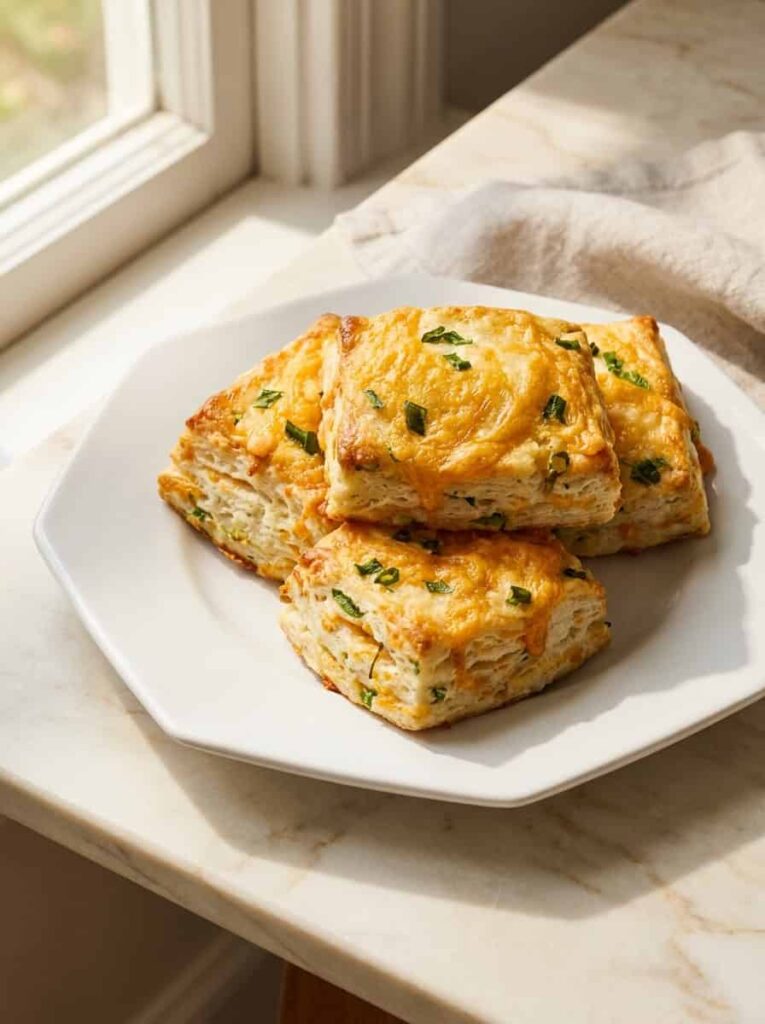
These are laminated biscuits — the dough gets cut into thirds and stacked three times before the final roll, which creates visible flaky layers rather than a uniform crumb. Sharp cheddar and scallions go in with the buttermilk and stay distributed through every layer. They bake at 450°F for 13 minutes and come out tall, golden, and layered in a way that drop biscuits never are.
Two things that determine whether these work: everything stays cold throughout — the butter, the buttermilk, two 10-minute freeze steps — and the cut-and-stack lamination happens three times. Shortcut either and you get a good biscuit but not a great one. The layers come from steam, and steam requires butter that’s cold enough to stay in distinct pieces rather than melting into the flour before it hits the oven.
Prep: 30 minutes · Bake: 13 minutes · Makes 12
What You Need
- 3½ cups soft wheat flour — White Lily preferred for tenderness; see note below on substitutes
- 2 tablespoons granulated sugar
- 1 tablespoon baking powder
- 2½ teaspoons kosher salt
- ½ teaspoon baking soda
- 1¼ cups (283g) cold unsalted butter, cubed — cold from the fridge, cut just before using
- 1 cup cold whole buttermilk
- 1 cup sharp cheddar, shredded, plus extra for sprinkling on top
- ½ cup scallions, thinly sliced, plus extra for topping
- 1 teaspoon black pepper
- 1 large egg, beaten — for brushing

On the flour: White Lily is a Southern soft wheat flour with lower protein than standard all-purpose, which makes a distinctly more tender biscuit. If you can’t find it, use 3 cups standard all-purpose flour plus ½ cup cake flour. Regular all-purpose alone works but the texture is slightly more structured and less delicate.
How to Make Them
Step 1: Mix the Dough and Freeze
Stir together the flour, sugar, baking powder, salt, and baking soda in a large bowl. Add the cold cubed butter and work it in quickly with your fingers — tossing and pinching until the mixture looks like coarse crumbs with some pea-sized butter pieces still visible.
Freeze the bowl for 10 minutes. This re-chills any butter that warmed from handling.
Stir in the cold buttermilk until a shaggy, rough dough forms — not smooth, not uniform. Add the cheddar, scallions, and black pepper and stir to distribute.
Step 2: Laminate the Dough
Turn the dough onto a lightly floured surface and pat into a rough rectangle. Cut it into thirds crosswise and stack the three pieces directly on top of each other. Pat back down into a rectangle.
Repeat this twice more — three rounds of cut-and-stack total. Each round multiplies the butter layers. Work quickly and use a bench scraper or knife to cut cleanly rather than tearing.
Step 3: Roll, Cut, Freeze, and Bake
Roll the dough into an 11×7-inch rectangle, roughly ¾ inch thick. Trim the edges to form a clean 10×6-inch rectangle — trimmed edges rise more evenly than ragged ones. Cut into 12 rectangles.
Arrange on the parchment-lined baking sheet about 1 inch apart. Freeze for another 10 minutes.
Brush with beaten egg. Sprinkle extra shredded cheddar and sliced scallions over the tops. Bake at 450°F for 13 minutes until deeply golden brown. Cool on the pan for 5 minutes before serving.
What Goes Wrong
Flat biscuits with no layers. Butter warmed up during mixing or the freeze steps were skipped. Cold butter is essential — work fast and freeze as directed.
Layers aren’t distinct. The cut-and-stack wasn’t done three times, or the dough was torn rather than cut cleanly. Three rounds, clean cuts.
Edges don’t rise as tall as the center. Skipped trimming the edges. Trimmed edges rise more uniformly than ragged pressed ones.
Make These for Brunch or Alongside Soup
These biscuits are the kind that become a thing people request. The cheddar and scallion combination is obvious in the best way — savory and bright, and the layered structure means the inside is completely different from the golden outside. They’re best within an hour of baking but hold reasonably well for a few hours at room temperature.
Tell me in the comments what flour you used and whether you did all three rounds of lamination. Rate the recipe, save it on Pinterest, and subscribe for more.
Print
Cheddar Scallion Biscuits
Laminated buttermilk biscuits with sharp cheddar and scallions folded through — a layered, flaky rectangular biscuit made by cutting and stacking the dough three times before the final roll. Baked at 450°F for 13 minutes. Golden, layered, savory.
- Total Time43 minutes
- Yield12 biscuits 1x
Ingredients
The Biscuit Dough
- 420 g soft wheat all-purpose flour (3 1/2 cups) — White Lily preferred; see note on substitutes
- 2 tbsp granulated sugar
- 1 tbsp baking powder
- 2.5 tsp kosher salt
- 0.5 tsp baking soda
- 283 g cold unsalted butter, cubed (1 1/4 cups / 2 1/2 sticks)
- 240 ml cold whole buttermilk (1 cup)
- 1 cup sharp cheddar cheese, shredded, plus more for topping
- 0.5 cup scallions, thinly sliced, plus more for topping
- 1 tsp black pepper
For the Top
- 1 large egg, beaten (egg wash)
Instructions
Make the Dough
- Mix the dry ingredients and butter: Preheat the oven to 450°F (230°C). Line a large rimmed baking sheet with parchment. Stir together the flour, sugar, baking powder, salt, and baking soda in a large bowl. Add the cold cubed butter and quickly toss and pinch it into the flour with your fingers until the mixture resembles coarse, crumbly sand with some pea-sized butter pieces. Freeze for 10 minutes.
- Add buttermilk and mix-ins: Stir in the cold buttermilk until a shaggy dough forms — it won’t look smooth and that’s correct. Stir in the cheddar, scallions, and black pepper.
Laminate the Dough
- Cut-and-stack three times: Turn the dough onto a lightly floured surface. Pat into a rough rectangle. Cut the rectangle into thirds and stack the thirds directly on top of each other. Pat back down into a rectangle. Repeat this cut-and-stack procedure two more times — three rounds total. This layering is what creates the distinct flaky layers in the finished biscuits.
Shape and Bake
- Roll and cut: Roll the dough into an 11×7-inch rectangle about ¾ inch thick. Trim the edges to form a clean 10×6-inch rectangle (this gives neater sides that rise more evenly). Cut into 12 rectangles, roughly 2½x2 inches each. Arrange about 1 inch apart on the prepared baking sheet. Scraps can be gently re-rolled once.
- Freeze, top, bake: Freeze the shaped biscuits on the sheet for 10 minutes to firm up the butter. Brush with the beaten egg. Sprinkle with additional shredded cheddar and sliced scallions. Bake at 450°F for about 13 minutes until deeply golden brown. Cool on the pan for 5 minutes before serving.
Notes
White Lily flour has a lower protein content than standard all-purpose flour, which produces a more tender biscuit. If you can’t find it, substitute with 3 cups standard all-purpose flour plus ½ cup cake flour, or use regular all-purpose flour with the understanding that the texture will be slightly more structured. All fat and liquid must be cold throughout — warm butter melts into the flour instead of staying in distinct pieces, which is what creates steam pockets and flaky layers in the oven. The two 10-minute freezes (after mixing the butter in, and again after shaping) are not optional. Work quickly when handling the dough; body heat warms the butter. The cut-and-stack lamination is the technique that creates the visible layers — skipping or under-doing it produces a biscuit with a more uniform, less layered crumb.
- Prep Time: 30 minutes
- Cook Time: 13 minutes
- Category: Bread, Breakfast, Side Dish
- Cuisine: American, Southern
Nutrition
- Calories: 340
- Sugar: 3
- Sodium: 480
- Fat: 22
- Saturated Fat: 14
- Carbohydrates: 28
- Fiber: 1
- Protein: 8