



I put off making a terrine for years. It looked like restaurant food, the kind of thing that needs a proper kitchen and someone who trained in France. Then I read through a recipe properly and realized the whole thing is basically a very rich meatloaf that gets treated with patience.
That’s it. That’s the secret. You mix seasoned pork with chicken livers and brandy, pack it into a loaf pan, bake it slowly in a water bath, and then leave it alone for a day and a half. The hands-on time is under an hour. Everything else is waiting.
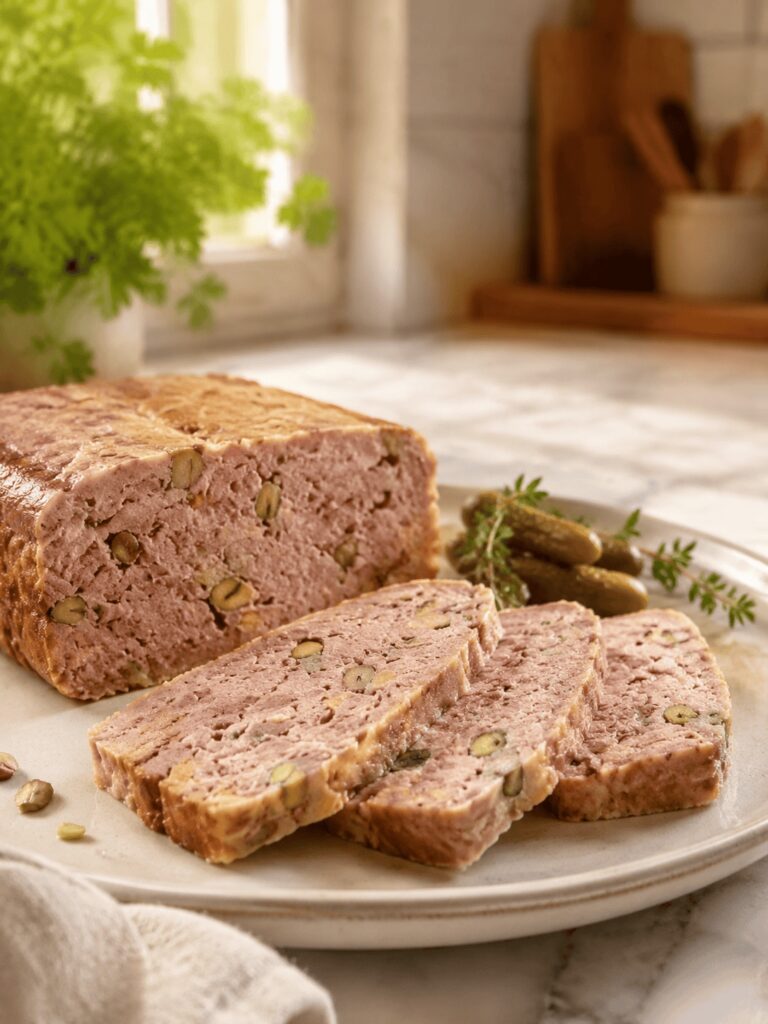
What comes out is a proper French country terrine with pistachios running through it, soft enough that you can almost spread it on bread with a knife. Serve it cold with a baguette, sharp mustard and a bowl of cornichons and you have the kind of thing people remember.
Please do not attempt this without a thermometer

I want to say this before anything else because it’s the one thing that will make or break your terrine.
You pull it out of the oven when the center reaches 68C / 155F. Not when it looks done. Not when the timer goes off. At that exact temperature.
Under it and the texture stays loose and the pork isn’t properly cooked. Over it and you lose the blush pink center, the fat renders out too far, and you end up with something dense and dry that tastes like an expensive meatloaf.
Here’s the part that trips people up. The temperature keeps climbing after the terrine leaves the oven. It’ll rise to around 75C / 167F about fifteen minutes later, then drift down to room temperature over the next couple of hours. That carryover is built into the recipe. Pulling at 68C feels early. Do it anyway.
An oven-safe probe thermometer is the easiest way to manage this because you can watch it without opening the door. If all you have is a regular meat thermometer, start checking at the sixty minute mark.
Fatty pork is doing the heavy lifting
The single biggest difference between a good terrine and a sad one is fat content.
Pork belly mince is what makes this sliceable and tender. Ask your butcher to mince pork belly with the rind cut off, or if you’re buying it pre-minced, look at it closely first. It should be pale pink with plenty of white flecks running through it. If it looks lean and uniformly rosy, it’s the wrong thing.
But all fatty pork would be too much. So it gets cut with regular pork mince at roughly two parts belly to one part regular. Regular mince at around fifteen percent fat works, or lean at ten percent if that’s what your shop carries.
The chicken livers are the ingredient people worry about, and they shouldn’t. They add a deep savory backbone without making the terrine taste of liver. Trim off any green or yellowish spots, which are genuinely bitter, and pull away obvious sinew. Small bits of membrane soften during the long slow bake and aren’t worth chasing.
Brandy is classic here and cognac is the traditional choice, but any brandy does the job. Don’t buy something expensive for this. If you’d rather skip alcohol entirely, low sodium chicken stock or a non-alcoholic wine will work, though you lose a background note that’s hard to replace.
The overnight marinade is not optional either
Mix the pork, livers, salt, pepper and brandy together with your hands the night before. Cover it, put it in the fridge, forget about it.
I tried skipping this once because I was short on time. The terrine was fine. It was noticeably less good. The overnight rest gives the salt time to penetrate the meat properly instead of sitting on the surface, and it lets the brandy work its way through everything rather than flashing off in the oven.
If you genuinely can’t wait, you’ll still get something decent. But this is a two day recipe already. One more night doesn’t change your life.
Slam it into the pan
This step sounds ridiculous until you understand what it’s doing.
Take a handful of the mixture and throw it firmly into the loaf pan. Not gently. Then press it down. Repeat four or five times until the pan is full, then pick the whole thing up and tap it hard on the counter a few times.
You’re driving out air pockets. Air pockets bake into brown spots and holes, and a terrine full of holes crumbles the moment you try to slice it. Packed tight, it cuts clean and holds together on the plate.
Cooking, resting, waiting
It bakes in a bain-marie, which is a fancy word for setting the loaf pan inside a roasting pan and pouring boiling water around it until the water comes halfway up the sides. The water buffers the heat so the outside doesn’t overcook while the middle catches up.
Twenty five minutes at 220C / 430F to get things moving. Then cover it loosely with foil, drop the oven to 170C / 340F, and let it go until the center hits temperature. Usually around seventy five minutes.
Then it sits on the counter for two hours. This isn’t idle time. As it cools, all the juices and rendered fat that got pushed out during cooking soak back into the meat. That’s where the softness comes from. The top will look pale and slightly unappetizing when it comes out of the oven and it darkens considerably as it cools, so don’t panic.
After that, wrap it and refrigerate overnight. The flavors need that night to settle into each other. This is the step people are most tempted to skip and it’s the one I’d defend hardest.
Getting it out and serving it
The next day, warm the outside of the pan briefly. A quick pass with a blowtorch is fastest, but dipping the pan in hot water or holding it over a low flame for a few seconds does the same thing. Then invert it onto a board.
Slice about a centimeter thick. The beautiful pink center fades within a few minutes of cutting, which is just the meat oxidizing in the air. Completely normal, not a fault, and it doesn’t change the taste.
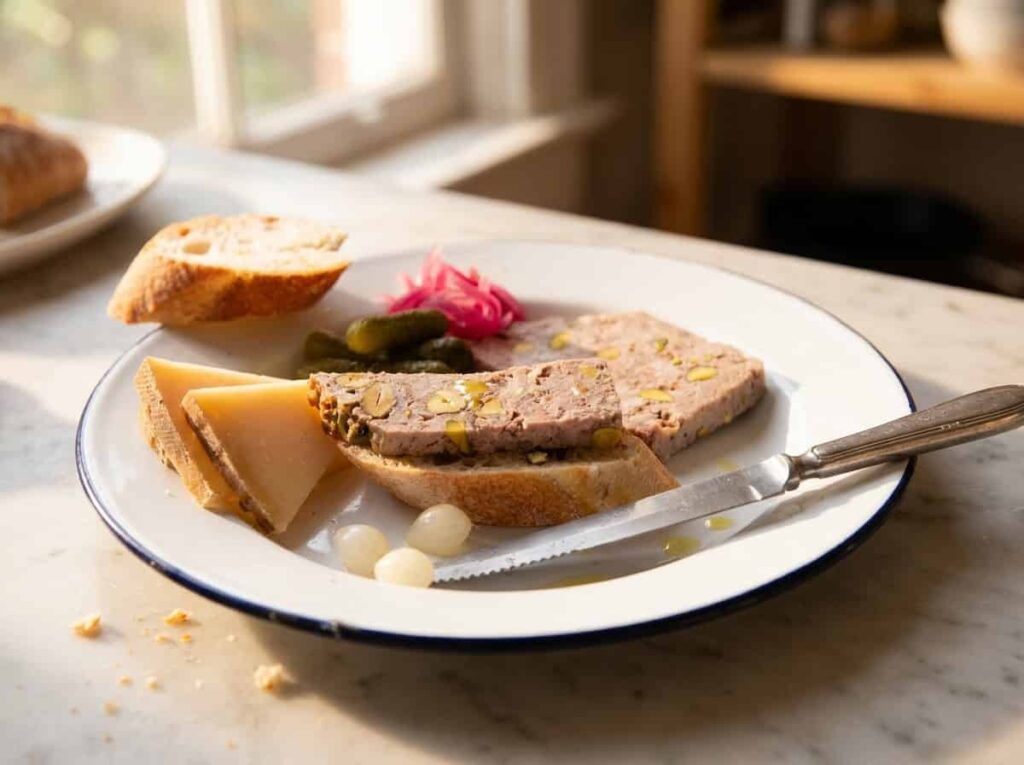
Serve at room temperature with crusty bread, Dijon and pickles. Spread a little mustard on the bread, add a slice of terrine, top with a cornichon.
It keeps in the fridge for five days and honestly it’s better on day two and three. It also freezes for three months if you slice it first and wrap the slices individually.
Print
Country Terrine with Pork and Pistachio
A classic French country terrine of fatty pork, chicken livers, brandy and pistachios, baked in a water bath and chilled overnight.
- Total Time50 hours 10 minutes
- Yield15 slices 1x
- DietGluten Free
Ingredients
Marinade
- 800 g pork belly mince (ground pork belly)
- 400 g pork mince (regular or lean)
- 250 g chicken livers (cleaned, diced 1cm)
- 4 tsp cooking or kosher salt
- 1 3/4 tsp black pepper
- 1/4 cup brandy (preferably cognac)
Terrine mixture
- 15 g unsalted butter (1 tablespoon)
- 1 eschalot (finely diced)
- 2 large eggs
- 2 egg yolks (from large eggs)
- 1/2 cup thickened cream (heavy cream)
- 1/2 cup unsalted pistachios (heaped, no need to toast)
For serving
- bread slices (baguette works well)
- Dijon mustard
- cornichons or other pickles
Instructions
Make the terrine mixture
- Marinate overnight. Place both pork minces and the chicken livers in a large bowl. Add the salt, pepper and brandy and mix well with your hands until evenly coated. Cover and refrigerate overnight.
- Preheat. Heat the oven to 220C / 430F (200C fan-forced).
- Cook the eschalot. Melt the butter in a small frying pan over medium heat. Add the eschalot and cook 3 minutes, stirring regularly, until softened but not golden. Set aside to cool slightly.
- Mix. Place the marinated meat in the bowl of a stand mixer. Add the cooked eschalot, eggs, egg yolks, cream and pistachios. Using the paddle attachment, mix on low for 30 seconds then medium for 30 seconds, until combined but still slightly coarse.
- Fill the pan. Take a handful of the mixture and slam it firmly into the loaf pan. Repeat 4 to 5 times, pressing down between each addition, then tap the pan firmly on the counter to settle it.
Cook and rest
- Bake in a water bath. Set the loaf pan in a roasting pan and pour boiling water around it until it reaches halfway up the sides. Bake 25 minutes.
- Lower the heat. Cover the terrine loosely with foil, still in the water bath. Reduce the oven to 170C / 340F (150C fan) and bake until the internal temperature reaches 68C / 155F, around 75 minutes.
- Rest. Remove from the oven and leave on the counter for 2 hours. The top darkens as it cools.
- Refrigerate. Cling wrap the terrine and refrigerate overnight.
- Unmould and serve. Warm the outside of the pan briefly with a blowtorch or hot water, then invert onto a board. Slice about 1cm thick and serve at room temperature with bread, mustard and pickles.
Notes
A thermometer is required. Pull at an internal temperature of 68C / 155F; carryover takes it to about 75C / 167F. If using curing salt it must be Cure #1, meant for cooked charcuterie, not Cure #2. Keeps 5 days refrigerated or 3 months frozen if sliced first.
- Prep Time: 30 minutes
- Cook Time: 1 hour 40 minutes
- Category: Appetizer
- Method: Baking
- Cuisine: French
Nutrition
- Serving Size: 1 slice
- Calories: 428
- Sugar: 0.4
- Sodium: 676
- Fat: 40
- Saturated Fat: 15
- Carbohydrates: 1
- Fiber: 0.1
- Protein: 14
- Cholesterol: 174