


Most versions of this bark start with saltine crackers, and there is nothing wrong with that. The salt cuts the toffee and the cracker turns into something crisp and completely unlike a cracker. But saltines bring salt and not much else, and I kept thinking the base could be doing more work.
Speculoos cookies do more work. They already taste of brown sugar and cinnamon, which is most of the way toward toffee before you have cooked anything. Pour hot butter and brown sugar over them and the two flavors collapse into each other. You lose the line between the cookie and the caramel entirely, which is exactly the point.
Seventeen minutes, four ingredients, and it makes a tray big enough to hand out.
Twenty four cookies, logo side down

Line a quarter sheet pan with parchment and lay twenty four cookies lengthwise across the bottom, printed side facing down.
The parchment is not optional. Toffee at temperature will find any gap and cement itself to bare metal, and you will spend a long evening with a scraper. Foil works if that is what you have, though it tears when you lift the finished slab.
Logo side down is a small thing that matters more than it should. The stamped side is uneven, and pressing that unevenness into the pan means the flat side faces up and takes the toffee in a smooth even coat. Face it up instead and the toffee pools in the grooves of the lettering and you get thick and thin patches across the whole tray.
Fit the cookies tight. Small gaps are fine, since the toffee bridges them, but a big gap becomes a hole in the finished bark and the piece breaks there.
A quarter sheet is what this quantity is built for. If you only have a 9 by 13 baking pan, line it and use that. Do not spread this across a half sheet, because the toffee layer thins out to nothing and the whole thing turns brittle rather than chewy. To fill a half sheet, double the recipe and buy the second package of cookies.
Four minutes of stirring, and no walking away
Half a cup of unsalted butter and half a cup of packed brown sugar go into a small saucepan over medium heat, and once they come to a low simmer you cook for four minutes, stirring the whole time.
Constantly. Not most of the time. Brown sugar has enough molasses in it that the solids drop to the bottom of the pan and scorch in seconds, and burnt toffee is a flavor you cannot cover up with chocolate. This is a four minute recipe step that requires four minutes of your attention, and it is the only part of the whole thing that does.
What you are watching for is texture rather than color. At the start the butter and sugar look separated and greasy. Around the two minute mark they come together into one glossy mixture. By four minutes it has thickened enough to coat the back of the spoon and pull slightly as you drag it through.
Pour it straight over the cookies and spread it out with a spatula while it is still hot and moving. It sets fast, so this is not the moment to go looking for a better spatula.
Eight minutes in a low oven
Three hundred degrees, eight minutes. Low, on purpose.
The oven is not really cooking the toffee, since you already did that on the stove. It is holding everything hot enough that the toffee spreads level, soaks into the top surface of the cookies, and bonds the layers into one sheet instead of a caramel lid sitting on loose biscuits. Higher heat pushes the sugar past where you want it and the bark turns hard and shattery.
Straight out of the oven, scatter three quarters of a cup of semisweet chocolate chips over the top and leave them alone for two or three minutes. They will not look like they are melting. They are. When they have gone glossy and slumped, spread them with a spatula or the back of a butter knife and the whole surface goes smooth.
Semisweet is what I use because the base is already sweet and it needs the contrast. Milk chocolate works if you are making this for children. Dark works if you like the bitter edge, and with these cookies it is a good combination.
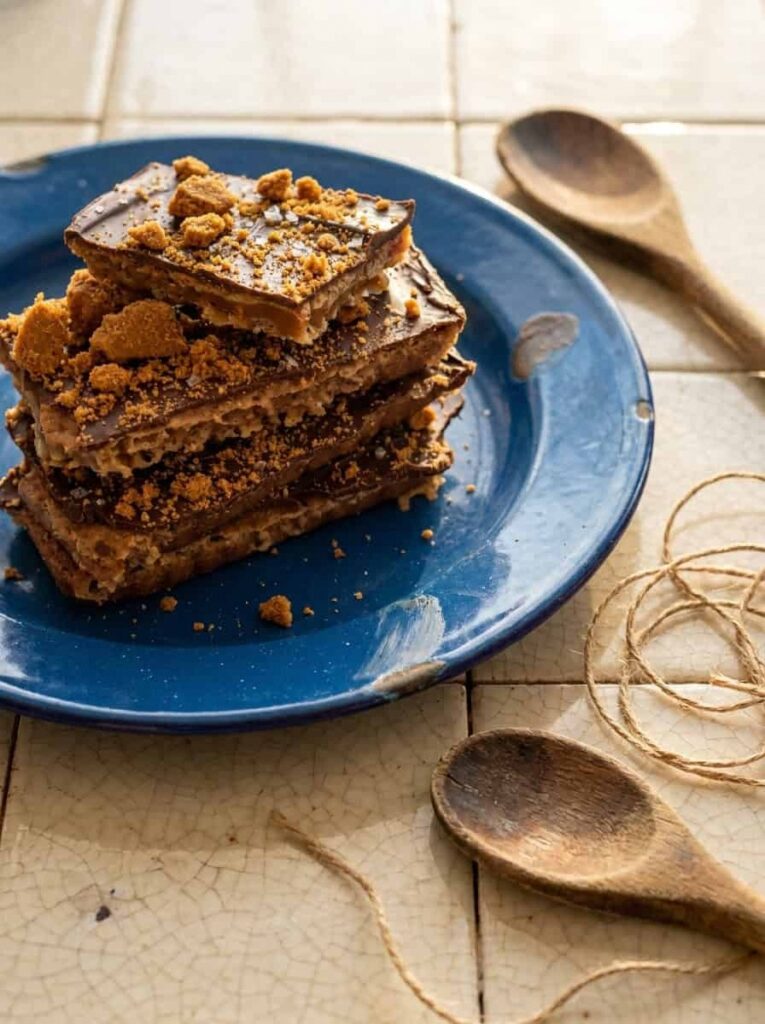
Then a pinch of flaky sea salt and a scatter of crushed leftover cookies while the chocolate is still soft enough to hold them.
One failure worth naming, since it happens to people once and then never again. If the toffee separates in the pan, so that you have a slick of clear butter floating on a grainy sugar layer, the heat was too high and the mixture broke. It usually happens when someone turns the burner up to speed the four minutes along. Take the pan off the heat and whisk hard, and it often comes back together. If it does not, pour it out anyway. Broken toffee bakes into something slightly greasy and slightly sandy, and it still tastes good under chocolate. Nobody has ever handed one back.
Setting, breaking, and keeping
Let it sit until the chocolate is completely hard before you touch it. At room temperature that takes an hour or so. In the fridge it takes about twenty minutes, though chilled chocolate sometimes sets with a dull grey bloom on the surface. It tastes identical and looks worse.
Then lift the whole slab off the pan by the parchment and break it with your hands. Not a knife. Toffee bark wants to fracture along its own lines and cutting it just crushes the edges into crumbs. Bend it over the edge of the counter and it snaps.
Store it in an airtight container in the fridge for up to a week. It softens noticeably at warm room temperature, so if your kitchen runs hot, the fridge is the answer rather than a suggestion.
Makes about 12 servings at 245 calories each, though nobody has ever eaten one piece.
Biscoff Toffee

Equipment
- Quarter sheet pan
- Parchment Paper
- Small Saucepan
Ingredients
- 1 package speculoos cookies 8.8 oz; you need 24 cookies
- 1/2 cup unsalted butter
- 1/2 cup brown sugar packed
- 3/4 cup semisweet chocolate chips
- sea salt optional, for topping
Instructions
- Line the pan and lay the cookies. Preheat the oven to 300F. Line a quarter baking sheet with parchment paper. Lay 24 cookies lengthwise in the pan, logo side down, fitted close together. Set aside.
- Cook the toffee. In a small saucepan, heat the butter and brown sugar over medium heat until it comes to a low simmer. Cook, stirring constantly, for 4 minutes. Stir the whole time or the molasses solids will scorch on the bottom.
- Pour and spread. Pour the butter mixture over the cookies and spread it evenly with a spatula while it is still hot and moving.
- Bake. Bake 8 minutes.
- Add the chocolate. Remove from the oven and immediately scatter the chocolate chips over the top. Let them sit 2 to 3 minutes to soften, then spread the chocolate with a spatula or butter knife.
- Top and set. Sprinkle with a pinch of sea salt and the leftover crushed cookies. Leave until the chocolate has hardened completely.
- Break it up. Lift the slab off the pan by the parchment and break it into pieces by hand.