


Here is the thing about grilled peaches that took me years to figure out: the fruit should never touch the grates.
Every version I made before this one came off the grill with black stripes and a raw middle. Peaches are mostly water and sugar, and grill bars are ferocious in a very narrow line. You get char where the metal was and nothing anywhere else. So these grilled peaches go into a cast iron skillet that sits on the grill, into a puddle of sugar that has already melted into caramel. The whole cut face makes contact. The whole cut face browns.
You still get the grill. The smoke, the outdoor heat, the fact that dessert happens where everyone already is. You just stop asking the grates to do a job they are bad at.
Fifteen minutes, four ingredients if you count the salt.
Why the sugar goes in first
This is a dry caramel, which is the simplest kind and also the one people are most nervous about.
Two tablespoons of granulated sugar go into a dry 12-inch cast iron skillet, spread in an even layer, over a grill preheated to medium-high. Somewhere around 400 to 450 degrees. Nothing else in the pan. No butter, no water. The sugar sits there looking inert for a while and then the edges go clear and slide, and about four minutes in you have a shallow layer of amber caramel.
Rotate the skillet as it goes. Grills have hot spots, cast iron holds heat unevenly across that width, and if you leave the pan still you will get one dark patch and one still granular. A quarter turn every minute is enough.
Then the fruit goes in cut side down, straight onto the caramel. It hisses. The sugar seizes slightly around the fruit and then loosens again as the peaches give up juice, and three or four minutes later the cut faces are properly browned rather than striped.
Peaches, plums, and the ripeness question

Four large peaches, around eight ounces each, halved and left unpeeled. Or eight plums at roughly four ounces each, same treatment. The skin stays on. It holds the half together and it slips off easily on the plate if anyone objects.
Ripeness matters more than variety. You want fruit that gives slightly at the seam and smells like something when you hold it near your face. Rock hard fruit will caramelize on the surface and stay squeaky underneath. Very soft fruit collapses into the caramel and turns to jam, which tastes good and looks like nothing.
Freestone peaches make your life easier, since the halves come away from the pit cleanly. Clingstone will fight you and you will end up hacking at them, which leaves the cut face ragged, and a ragged face does not brown evenly. Most of what you find at a farmers market in late summer is freestone. Early season fruit tends to cling. If you cannot tell, cut one and look.
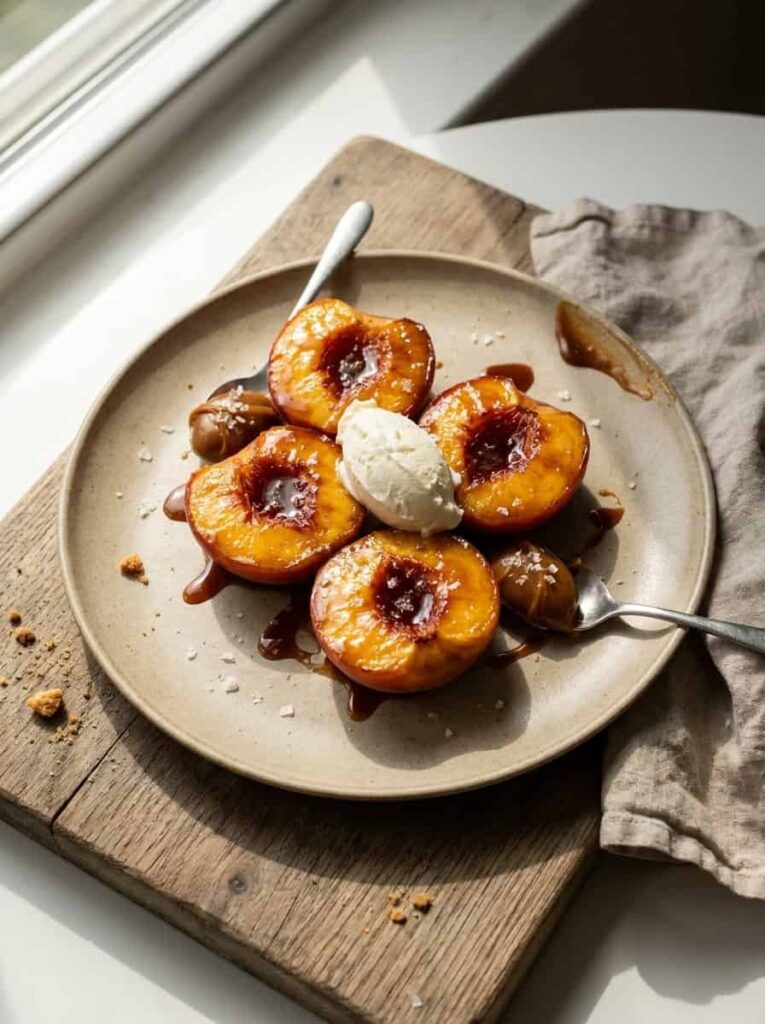
For serving, dulce de leche and mascarpone from a jar and a tub respectively. Both are store-bought here and there is no reason for that to be otherwise. Crème fraîche works in place of mascarpone and brings a sour note that I actually prefer with plums, though not with peaches. Flaky sea salt at the end is not decoration. The dish has three sweet elements in it and the salt is the only thing holding the line.
People ask why not ice cream, and the answer is temperature. Ice cream on hot glazed fruit turns into a puddle within thirty seconds and the caramel seizes against the cold. Mascarpone sits at room temperature, holds its shape against the heat, and tastes of almost nothing on its own, which is what you want next to something this sweet. Use a small spoon and put it alongside the fruit rather than on top of it.
The amaretto step, done carefully
Once the fruit is browned, take the skillet off the heat before you add the amaretto. Off the heat. Two tablespoons, poured in carefully.
This matters. You are adding alcohol to a pan that is well above 400 degrees, and doing it over an open flame is how people lose their eyebrows. Pull the pan, pour, then return it to the grill.
Back on the heat, swirl the skillet constantly for about a minute. The amaretto thins the caramel, picks up the fruit juices, and turns into a glaze. You will feel the fruit release from the pan when it is ready. Before that point it is stuck and pulling at it will tear the faces off.
Then move fast. Get the fruit onto plates cut side up, spoon the glaze over, add mascarpone and dulce de leche alongside, and finish with the salt. Caramel does not wait around. Left in a hot cast iron pan it keeps cooking and goes bitter, and left to cool it welds itself to the bottom.
What can be done ahead, and what cannot
The fruit can be halved and pitted up to four hours in advance. Keep it covered in the fridge and cut side down on a plate so the faces do not dry out and discolor.
That is the extent of the make-ahead. The cooking and the serving are one continuous motion. Glazed fruit held even fifteen minutes goes slack, the caramel dulls, and the mascarpone starts sliding off a warm surface instead of sitting on it. If dinner is running late, hold the fruit and cook it when people are actually sitting down.
For cleanup, put the empty skillet back on the still-hot grill and add a cup of water. It will spit. The hardened caramel dissolves in about a minute and the pan wipes clean, which is much better than soaking it overnight and scraping.
One last thing. If you only have a charcoal grill, bank the coals to one side and set the pan over them the same way. The instruction to use one side of a gas grill is about controlling the heat, not about the fuel.
Serves 4.
Grilled Peaches with Dulce de Leche and Mascarpone

Equipment
- 12-inch cast-iron skillet
- Gas or charcoal grill
Ingredients
- 2 tablespoons granulated sugar
- 4 large unpeeled fresh peaches about 8 oz each, halved and pitted; or 8 large plums at about 4 oz each
- 2 tablespoons amaretto
- store-bought dulce de leche and mascarpone cheese or creme fraiche for serving
- flaky sea salt for garnish
Instructions
- Heat the pan. Place a 12-inch cast iron skillet on one side of a gas grill. Preheat that side of the grill to medium-high, 400F to 450F.
- Make the dry caramel. Sprinkle the sugar in an even layer in the skillet. Cook uncovered until melted and beginning to brown, about 4 minutes, rotating the skillet as needed so it melts evenly.
- Caramelise the fruit. Place the fruit cut side down in an even layer on the melted sugar. Cook uncovered until the cut faces are browned and caramelised, 3 to 4 minutes, rotating the skillet as needed.
- Add the amaretto off the heat. Remove the skillet from the heat and carefully add the amaretto. Adding alcohol to a pan over an open flame is a fire risk, so pull the pan first.
- Glaze. Return the skillet to the grill and cook uncovered, swirling the pan constantly, until the fruit releases from the skillet and is glazed, about 1 minute.
- Serve immediately. Move the fruit to a platter or plates, cut side up. Spoon the glaze over, serve with mascarpone and dulce de leche, and finish with flaky sea salt.