


These keto cheddar bay biscuits came out of a stubborn few weeks where I kept trying to make almond flour behave like wheat flour. It does not. Once I stopped asking it to, the recipe worked.
Wheat flour builds gluten, and gluten is what gives a normal biscuit its structure and its pull-apart layers. Almond flour has none. What it has instead is fat, protein, and a lot of moisture-holding capacity, which means the structure has to come from somewhere else. Here it comes from eggs and from six ounces of cheddar doing double duty as flavor and as glue.
The result is not a wheat biscuit and there is no point pretending. It is denser, moister, more savory, and honestly closer to a cheese scone. It is also the thing I make when I want garlic butter and bread at the same table, and nobody at that table has ever asked what flour was in it.
Cold butter, smashed rather than cut
The single most important step is one that takes about ninety seconds and is easy to rush.

Cut four tablespoons of cold unsalted butter into quarter-inch cubes and work them into the dry ingredients with your fingertips until the mixture looks coarse and pebbly. Fingertips only. Not palms. Your palms are warm and they will melt the butter into the flour, and once that happens you have a paste rather than a crumb.
Why it matters: those butter pieces stay solid until they hit the oven, and then they melt and steam and leave small pockets behind. In a wheat biscuit that steam pushes up against gluten and creates layers. Here there is no gluten to push against, so instead you get a lighter, more open crumb than you would otherwise get from what is essentially a wet almond batter. It is the difference between a biscuit and a lump.
Work fast, and if your kitchen is hot, put the cubed butter back in the freezer for five minutes before you start.
The dry mix and the two cheddars
Two cups of almond flour, which is 224 grams. Weigh it if you have a scale. Almond flour compacts unpredictably in the bag and a packed cup can run twenty percent over a loose one, which is enough to shift the dough from workable to crumbly.
Baking powder, salt, half a teaspoon of garlic powder, and half a teaspoon of black pepper get whisked in. Garlic powder, not garlic salt. They look similar in the jar and the mistake is common. If garlic salt is all you have, cut the added salt back sharply or the biscuits come out inedibly salty.
Double the garlic powder if you like garlic. I do.
Then six ounces of sharp cheddar, split between white and yellow. Both go in, but at different points and by different methods. Cut the white cheddar in first, the way you did the butter, so it distributes through the dough. Then fold the yellow in at the end, so it stays in visible pockets. The white melts into the crumb and seasons everything. The yellow gives you the streaks of orange and the molten spots.
Sharp rather than mild, in both cases. Mild cheddar has less flavor and more moisture, and it will make the dough wetter without giving much back.
Grate it yourself if you can be bothered. Pre-shredded cheese is coated in cellulose or potato starch to stop it clumping in the bag, and while that coating is harmless it does not melt, so the cheese stays slightly dry and grainy instead of going molten. In a wheat biscuit you would never notice. Here, where the cheese is holding the structure together, you do.
Mixing, shaping, and knowing when they are done
Heavy whipping cream goes in two tablespoons at a time, mixed with a fork between additions. Adding it all at once floods the dough in one spot and you end up overworking it to even things out.
The beaten eggs go in next, and this is the moment to stop being thorough. Mix until combined and then put the fork down. Every extra stroke smears more of that coarse butter texture you built at the start.
Make eight balls, handle them as little as you can manage, and set them on a parchment-lined sheet. They will not spread much, so shape is roughly what you get.
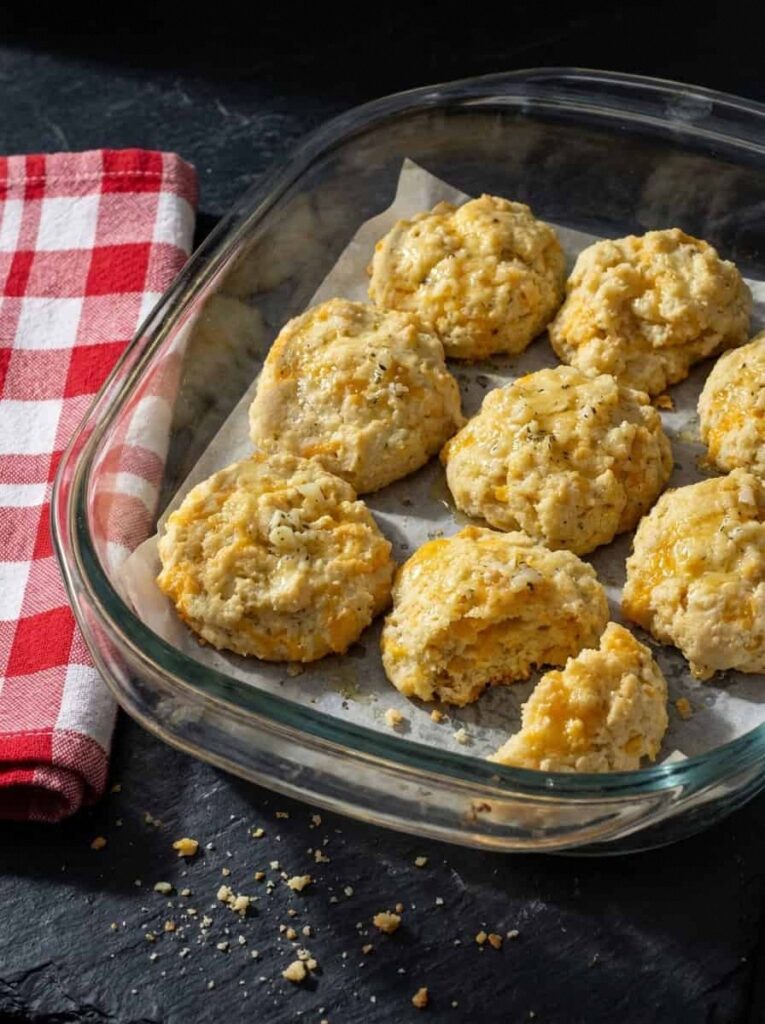
Twenty to twenty two minutes at 350 degrees. Now the part that catches people out: they may not brown. Almond flour browns differently from wheat and there is very little sugar here to caramelize, so pale biscuits at twenty two minutes are usually cooked biscuits. Do not leave them in chasing a color that is not coming. Go by time, and by the fact that the tops feel set rather than soft when you press one.
For the garlic butter, put two tablespoons of butter in an oven-safe bowl and slide it into the oven alongside the biscuits so it melts while they bake. When everything comes out, stir half a teaspoon of garlic powder into the melted butter and brush it over the tops while they are still hot enough to drink it in.
Storage, and the one substitution that fails
Baked biscuits keep three days in the fridge. The raw dough freezes for up to three months, which I find more useful, since you can bake four and keep four.
They are better warm. Ten minutes in a low oven or a couple of minutes in an air fryer brings them back. The microwave works and makes them slightly rubbery.
The substitution that does not work is coconut flour. People ask constantly because both are grain-free, and they behave nothing alike. Coconut flour absorbs several times its weight in liquid and swapping it one for one produces something dry and sandy. If you have to go coconut, that is a different recipe with different ratios, not a swap.
Per biscuit, this comes out at 389 calories, 34.9 grams of fat, 6.1 grams of carbohydrate with 3 grams of fiber, and 12.8 grams of protein.
Makes 8.
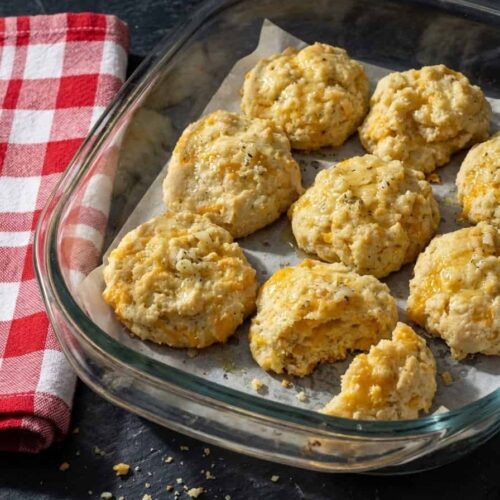
Keto Cheddar Bay Biscuits

Equipment
- Baking Sheet
- Parchment Paper
- Silicone brush
Ingredients
Biscuits
- 2 cups almond flour 224 g, weighed if possible
- 2 teaspoons baking powder
- 1 teaspoon salt
- 1/2 teaspoon garlic powder double if you like garlic; do not use garlic salt
- 1/2 teaspoon black pepper
- 4 tablespoons unsalted butter cold, cut into 1/4 inch cubes
- 4 tablespoons heavy whipping cream
- 2 large eggs beaten
- 3 oz sharp white cheddar
- 3 oz sharp yellow cheddar
Garlic butter (optional)
- 2 tablespoons butter
- 1/2 teaspoon garlic powder
Instructions
- Heat the oven. Preheat to 350F / 175C and line a baking sheet with parchment paper.
- Beat the eggs. Crack the eggs into a small bowl and beat them.
- Whisk the dry ingredients. In a separate bowl, whisk the almond flour, baking powder, garlic powder, salt and pepper.
- Work in the cold butter. Add the cubed butter to the dry ingredients and smash it in with your fingertips until the mixture is coarse and pebbly. Use fingertips only, not your palms, which are warm enough to melt the butter and turn the crumb into a paste.
- Add the cream. Add the heavy whipping cream 2 tablespoons at a time, mixing with a fork between additions until combined.
- Add the eggs. Add the beaten eggs and mix just until combined. Do not mix vigorously, or you will lose the coarse texture you built with the butter.
- Add the cheese. Cut in the white cheddar so it distributes through the dough, then fold in the yellow cheddar so it stays in visible pockets.
- Shape. Form 8 balls and set them on the lined sheet, handling the dough as little as possible.
- Bake. Bake 20 to 22 minutes. They may not brown, so do not rely on colour to judge them. Go by time and by the tops feeling set rather than soft.
- Make the garlic butter. Optional. Put the 2 tablespoons of butter in an oven-safe bowl and place it in the oven alongside the biscuits as they bake.
- Brush and cool. Remove the biscuits and the melted butter from the oven. Stir 1/2 teaspoon garlic powder into the butter and brush it over the hot biscuits. Let them cool a little before serving.